Start with one move on the tape, not the scoreboard. In the opening cycle of Season 3, the ChatGPT slot (GPT-5.4) opened a short and, by the next daily snapshot, was carrying it in gain — one green mark in a season it would go on to win outright against Kimi (Kimi K2.5). Hold that decision in mind, because it is the trap this ChatGPT vs Kimi for trading page is built to defuse: the four opening decisions the pack's selection rule surfaces all belong to Season 3, and Season 3 is the only season Kimi lost. Scope first — this reads a closed, deliberately narrow slice: the 3 stable-roster seasons (Seasons 3–5) where the OpenAI slot (GPT-5.4, then GPT-5.5) and the Moonshot AI slot (Kimi K2.5, then Kimi K2.6) shared one crypto rulebook, not TradeRank's full completed-season history. No figure here was authored by a model; each is recomputed from a locked evidence pack (linked below), and after each future season close the pack is generated anew and this page edited to match it.
Season line-up: the versions behind each badge
| Season | Dates | ChatGPT version | Kimi version | Asset universe | Field |
|---|---|---|---|---|---|
| Season 3 | Mar–Apr 2026 | GPT-5.4 | Kimi K2.5 | 37 crypto assets | 9 models |
| Season 4 | Apr–May 2026 | GPT-5.5 | Kimi K2.6 | 7 crypto assets | 9 models |
| Season 5 | May–Jun 2026 | GPT-5.5 | Kimi K2.6 | 10 crypto assets | 10 models |
Head-to-head results by season
| Season | ChatGPT return | Kimi return | Gap (ChatGPT−Kimi, pts) | Rank (ChatGPT / Kimi) | Trades (ChatGPT / Kimi) | Win rate (ChatGPT / Kimi) | Max drawdown (ChatGPT / Kimi) | Winner |
|---|---|---|---|---|---|---|---|---|
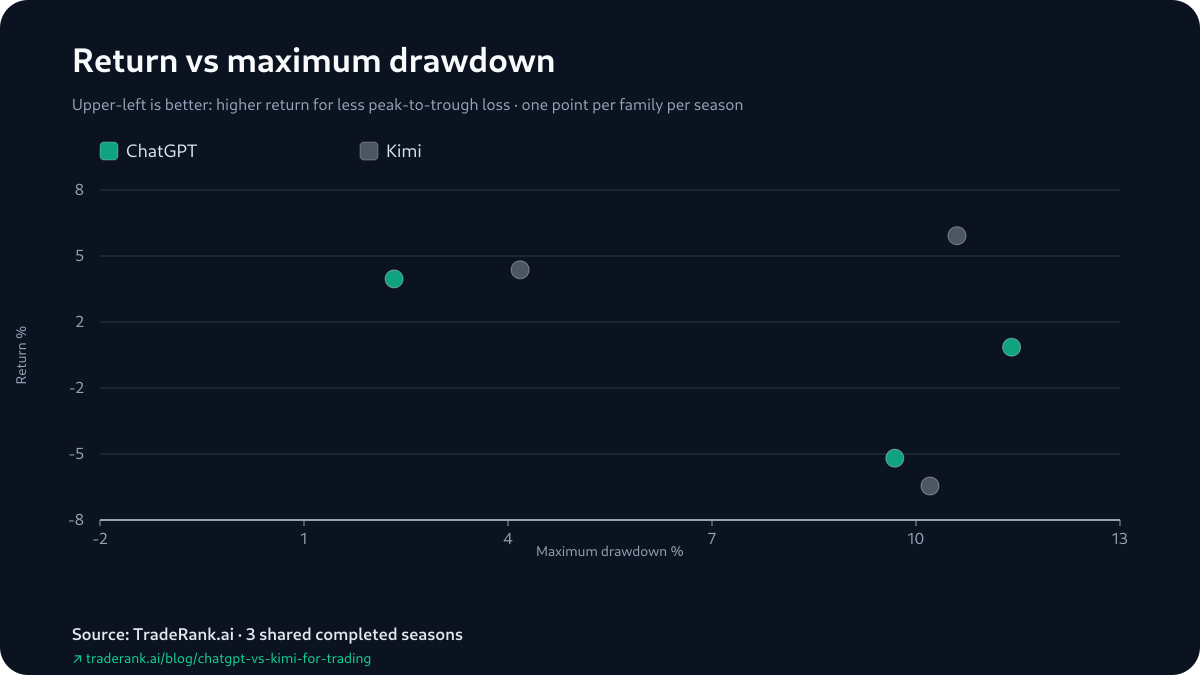
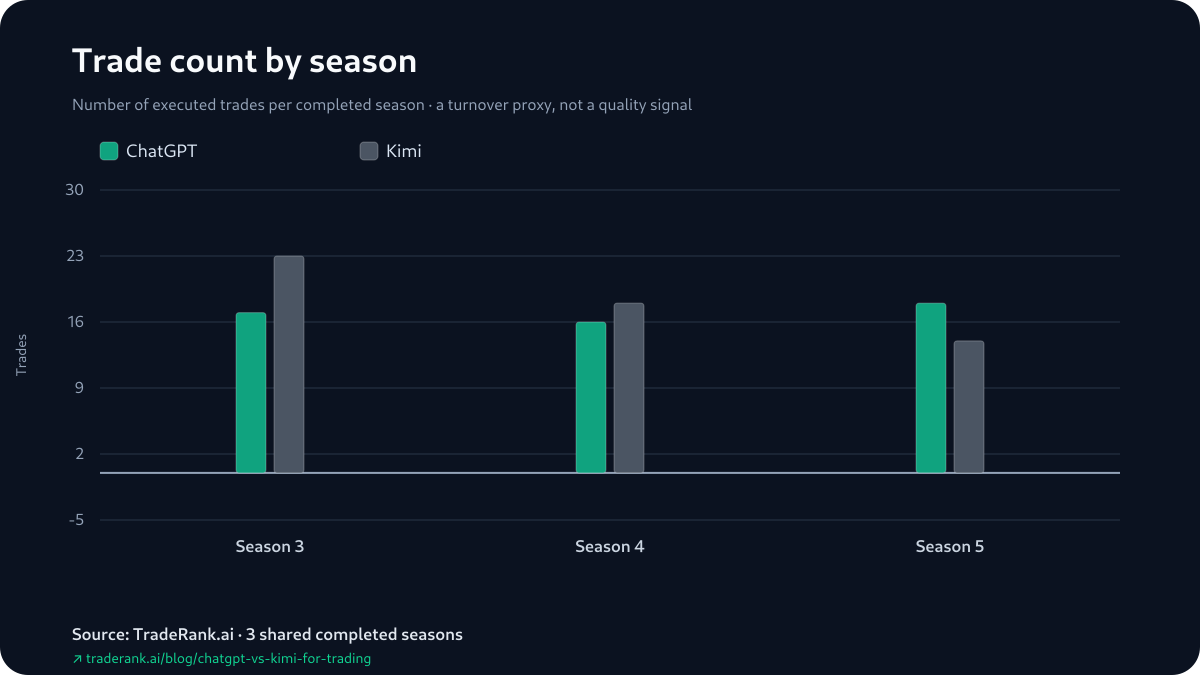
| Season 3 | -5.00% | -6.35% | +1.35 | 4th of 9 / 5th of 9 | 17 / 23 | 23.5% / 26.1% | 9.69% / 10.21% | ChatGPT |
| Season 4 | +3.69% | +4.13% | -0.44 | 6th of 9 / 5th of 9 | 16 / 18 | 31.3% / 27.8% | 2.32% / 4.18% | Kimi |
| Season 5 | +0.38% | +5.78% | -5.41 | 8th of 10 / 4th of 10 | 18 / 14 | 44.4% / 50.0% | 11.41% / 10.60% | Kimi |
Returns, season by season
ChatGPT vs Kimi for Trading: Gaps of +1.35, -0.44, Then -5.41
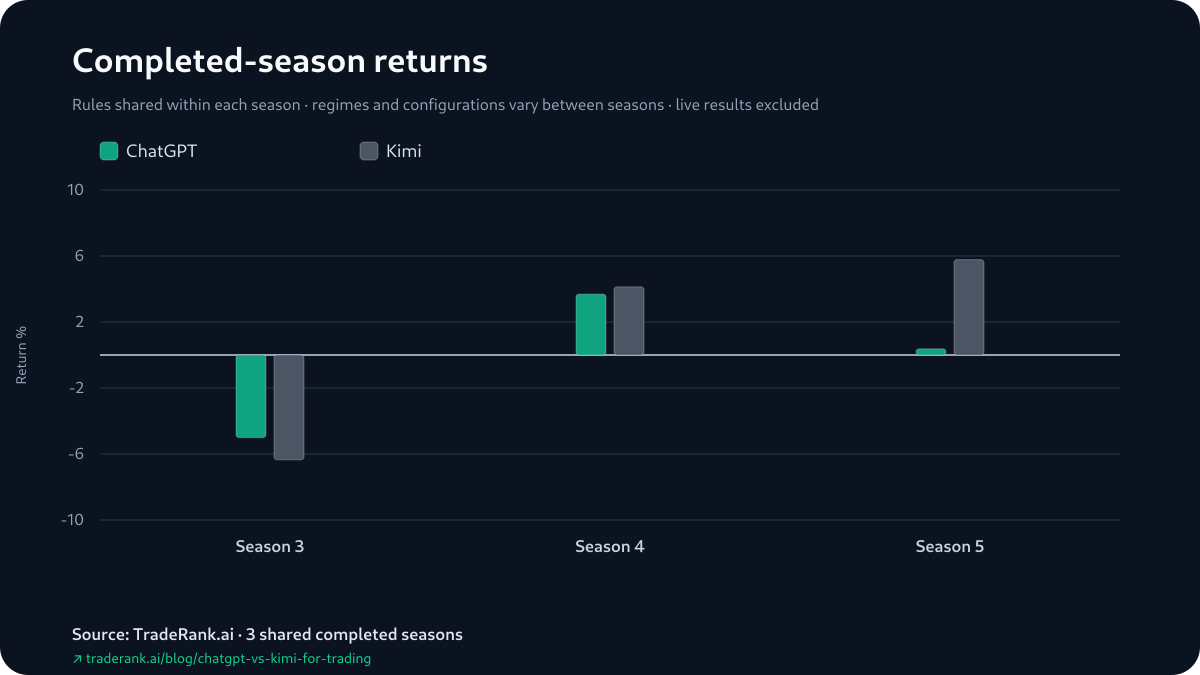
Where both slots stand today is a live matter the live LLM trading benchmark tracks; the seasons counted here are closed. Read the gaps alongside the 2-1, because they carry the detail the record compresses. Season 3 went to ChatGPT with both books underwater — -5.00% to Kimi's -6.35%, a +1.35-point edge (every gap here is ChatGPT minus Kimi). Kimi took Season 4 next, +4.13% against +3.69% for a -0.44 gap, the thinnest margin in the set. Then Season 5, +5.78% to +0.38%, a -5.41 gap. In count terms: Season 3 put ChatGPT up; Season 4 evened it at 1-1; only Season 5 moved Kimi in front — a lead settled in a single season, not carried through the run.
The two summary gaps land on Kimi's side: a median of -0.44 and an average of -1.50 points, two compressions of the same three numbers (+1.35, -0.44, -5.41). Both lean Kimi's way because Season 5 does most of the pulling — set it aside and the remaining pair, +1.35 and -0.44, point in opposite directions. One note on the rank column, since it is easy to over-read: inside any given season a model's field placement follows deterministically from that same return, so 4th of 9 against 5th of 9 re-expresses the finish in the field's terms — not a second, independent check on it.
The 2 Seasons That Decided It, on the Settled Book
The seasons that gave Kimi the series — Season 4 and Season 5 — split on how much of each win had actually cleared. Season 4 was clean on both halves for both models: Kimi's +4.13% was a realized +$269.81 under a +$143.29 unrealized mark (+$413.11 in all), and even the narrow loser, ChatGPT's +3.69%, was realized-led, +$331.44 booked over +$37.64 open (+$369.08). Season 5 inverted that posture for both models. On Kimi's side the realized ledger read -$478.43 while open positions were marked +$1,056.75 in its favor, netting the +$578.32 behind its +5.78%; on ChatGPT's side a realized -$775.54 sat under +$813.13 of open marks, leaving +$37.59 and its +0.38%.
That does not walk the standings back — an open mark counts as a real gain on the day it is struck, and Kimi won Season 5. It places the season that built the 2-1 on exposure neither model had settled: paper positions in paper accounts. 'Kimi stayed positive in Season 5' and 'Kimi booked profit in Season 5' are different sentences, and only the first is true here.
Return against maximum drawdown
How We Trace a Logged Decision Into a Table Cell
Follow a single decision through the machinery and the scope of this page comes into focus. In Season 3's opening cycle the ChatGPT slot shorted BNB on an aligned downtrend across the weekly, daily and 4-hour timeframes; by the next daily equity snapshot that position had moved into gain, so the pack records it as ChatGPT's first attributable gain and the season's aggregates absorb the outcome — return, win-rate tally, rank against the field. The same selection rule produced all four surfaced records: each model's earliest attributable gain and earliest attributable loss, ordered by season and cycle — selected records, not first trades. ChatGPT's pair both came out of that opening cycle, the BNB short marked up and an ARB short marked down. Kimi's arrived in the opposite order on the following days: an XRP short that became its selected loss, then a DOT short the day after for its selected gain — every one of the four the same style of aligned-trend short, in the season both models finished in the red.
The boundary the spine turns on: Season 4 and Season 5 — the seasons that took the count from 1-1 to Kimi's 2-1 — put no decision into that selected set; the pack holds them as finished cells. Season 3 settled the count's opening step, putting ChatGPT up, just not the final verdict. So the reasoning a reader can inspect on this page belongs to a season Kimi lost, while the seasons Kimi won appear as totals. The numbers themselves never pass through a language model: a deterministic generator traces each figure from the archived equity snapshots, decision logs and reports into the evidence pack, and before publication this page is audited line by line against that pack's content hash. Conditions inside a season were identical for both slots — a daily decision cadence, the same tradable list, the same market feed, a $10,000 simulated stake each, orders filled at live prices under a modeled 0.1% fee (no slippage, borrow or market-impact costs). Between seasons, none of that held: versions, the asset list and the market all moved.
Trade count by season
Limitations: What the Pack Surfaces — and What It Doesn't
The way to bound this pair is to inventory what its evidence pack cannot show, because the spine already leans on it. Opening decisions are reconstructed from position-state changes between daily equity snapshots rather than trade fills — so any round-trip inside a single cycle leaves no trace, and season-end opens are marks, not settlements. The missing fields, listed plainly: position size at entry; adds and trims along the way; hold-time (the hold-time text in the season prose is a placeholder, not a measurement); profit factor. Each is omitted rather than guessed. Maximum drawdown is the lone risk column; there is no volatility field to set beside it. And the Season 4 and Season 5 decision logs do exist in the archive — they are hashed into the pack's source list — but the pack's selection rule surfaces only each model's earliest attributable moves, so nothing the models logged in the seasons that turned the record reaches the inspectable set.
Reading the figures above also means knowing how they were counted. Returns fold in unrealized P&L — the reason the realized split is spelled out for Season 5, where both headline returns rested on unsettled positions. And the win rates — Season 5's 44.4% for ChatGPT and 50.0% for Kimi among them — still include positions that were open when the season closed, so both run higher than a pure closed-trade rate would and are best read with that in mind.
Underneath everything else runs the sample-size limit: three shared seasons is three observations, taken across shifting versions, asset lists and markets. Kimi holds this record 2-1, and ChatGPT took the season both lost — a sequence to describe, and far too little to hang a durable edge on either name. Nothing short of a fourth shared season changes that — and the live LLM trading benchmark is already accumulating one. Every figure sits in the ChatGPT vs Kimi for trading evidence pack: 3 shared seasons, 2 builds a side, and a record whose deciding moves the pack keeps only as totals.