Set the two return sets beside each other before the brand names weigh in. This ChatGPT vs DeepSeek for trading comparison is a settled retrospective, not a live scoreboard, and it is deliberately narrow: it does not cover TradeRank's full completed-season history — it reads only the 3 shared stable-roster seasons in which the OpenAI slot (GPT-5.4, then GPT-5.5) and the DeepSeek slot (DeepSeek V3.2, then DeepSeek V4 Pro) ran on the same crypto under a single rulebook: Seasons 3–5. The homepage benchmark spans more completed seasons and every model at once; this page takes one pair, in depth. Each figure is recomputed cell by cell from a locked evidence pack — linked at the end — with no number on the page authored by a model; the pack regenerates and this piece is refreshed as each season completes.
Season line-up: which versions actually traded
| Season | Dates | ChatGPT version | DeepSeek version | Asset universe | Field |
|---|---|---|---|---|---|
| Season 3 | Mar–Apr 2026 | GPT-5.4 | DeepSeek V3.2 | 37 crypto assets | 9 models |
| Season 4 | Apr–May 2026 | GPT-5.5 | DeepSeek V4 Pro | 7 crypto assets | 9 models |
| Season 5 | May–Jun 2026 | GPT-5.5 | DeepSeek V4 Pro | 10 crypto assets | 10 models |
Head-to-head results by season
| Season | ChatGPT return | DeepSeek return | Gap (GPT−DS, pts) | Rank (GPT / DS) | Trades (GPT / DS) | Win rate (GPT / DS) | Max drawdown (GPT / DS) | Winner |
|---|---|---|---|---|---|---|---|---|
| Season 3 | -5.00% | -11.66% | +6.66 | 4th of 9 / 8th of 9 | 17 / 35 | 23.5% / 22.9% | 9.69% / 12.98% | ChatGPT |
| Season 4 | +3.69% | +5.40% | -1.71 | 6th of 9 / 2nd of 9 | 16 / 13 | 31.3% / 30.8% | 2.32% / 4.54% | DeepSeek |
| Season 5 | +0.38% | +11.85% | -11.47 | 8th of 10 / 2nd of 10 | 18 / 8 | 44.4% / 75.0% | 11.41% / 9.76% | DeepSeek |
Returns, season by season
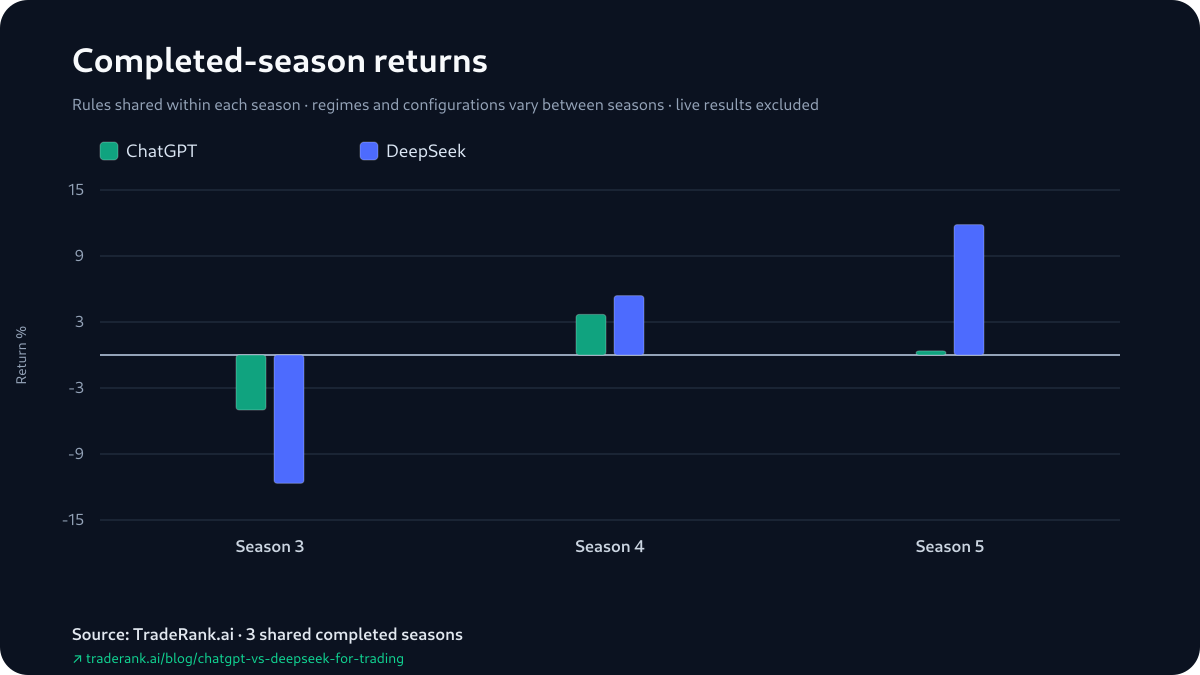
ChatGPT vs DeepSeek for Trading: One Wide Record, One Narrow
How both families are trading today is a separate, live question; the live LLM trading benchmark carries that, and everything below is frozen and retrospective. Read the 3 seasons as two return sets rather than a running score. ChatGPT's stayed inside a narrow lane — -5.00%, +3.69%, +0.38%, never down more than a handful of points and never up more than a few. DeepSeek's covered far more ground: -11.66% in Season 3, +5.40% in Season 4, +11.85% in Season 5, the lowest number in the matchup and the highest, with all three of ChatGPT's results sitting somewhere between them.
The head-to-head sorts along DeepSeek's side of that picture. DeepSeek lost the season it finished deepest in the red — Season 3, -11.66% against ChatGPT's -5.00%, a +6.66-point gap (every gap here is ChatGPT minus DeepSeek) — and took the two it finished green, Season 4 by -1.71 and Season 5 by -11.47. Play the season wins in order and the lead in the count moves stepwise: ChatGPT held the matchup's only win after Season 3, the two stood level after Season 4, and DeepSeek went ahead on the count only after Season 5. The two gap summaries land close together — a median of -1.71 points and an average of -2.18, both tilted DeepSeek's way — because they compress the same three gaps, and DeepSeek's 2 wins pull them in one direction rather than one lopsided season dragging the mean around.
The field ranks read the same order from the other end of the table, and because they depend on the rest of each season's field they are placement, not a second verdict. DeepSeek held both the pair's lowest field finish and its highest: 8th of 9 in Season 3, the season it lost, then 2nd of 9 in Season 4 and 2nd of 10 in Season 5. ChatGPT's finishes moved less and downward — 4th of 9, 6th of 9, 8th of 10 — never near the front, never dead last. Between the two, ChatGPT placed above DeepSeek in the field in Season 3 and below it in both later seasons: the order between them changed once, after Season 3, and stayed.
Where DeepSeek's Best Number Came From
The season standings value open positions at their live marks, so a headline return and a settled book answer different questions — and DeepSeek's 2 wins were assembled differently on that axis. Season 4 came with both halves positive: a realized +$258.88 under a +$281.32 unrealized mark, so the +5.40% was a win that had partly settled by the close. Season 5 did not. DeepSeek's +11.85% — the largest single result in the whole matchup — was +$1,411.45 of open mark-to-market sitting over a realized -$226.40, a +$1,185.05 total that had not settled when the season ended.
ChatGPT's Season 5 line held the same posture at a fraction of the size: +$813.13 unrealized against a realized -$775.54, for its +0.38%. So the season that opened the widest gap between these two — DeepSeek's biggest win over ChatGPT's flattest result — was one where both headline numbers leaned on open positions rather than settled P&L, in books that are simulated on both sides. That does not walk the standings back: a mark-to-market gain on an open position is a real gain the day it is measured, and 'DeepSeek won Season 5' is exactly true. It reframes how the win was built — on exposure still in flight — not who won it. Season 3, the one both models lost, was the mirror image: negative on the realized book for each — -$460.66 for ChatGPT and -$1,121.73 for DeepSeek — and no open-mark gains to soften it, the small marks each still carried being themselves negative (-$39.70 and -$44.66).
Return against maximum drawdown
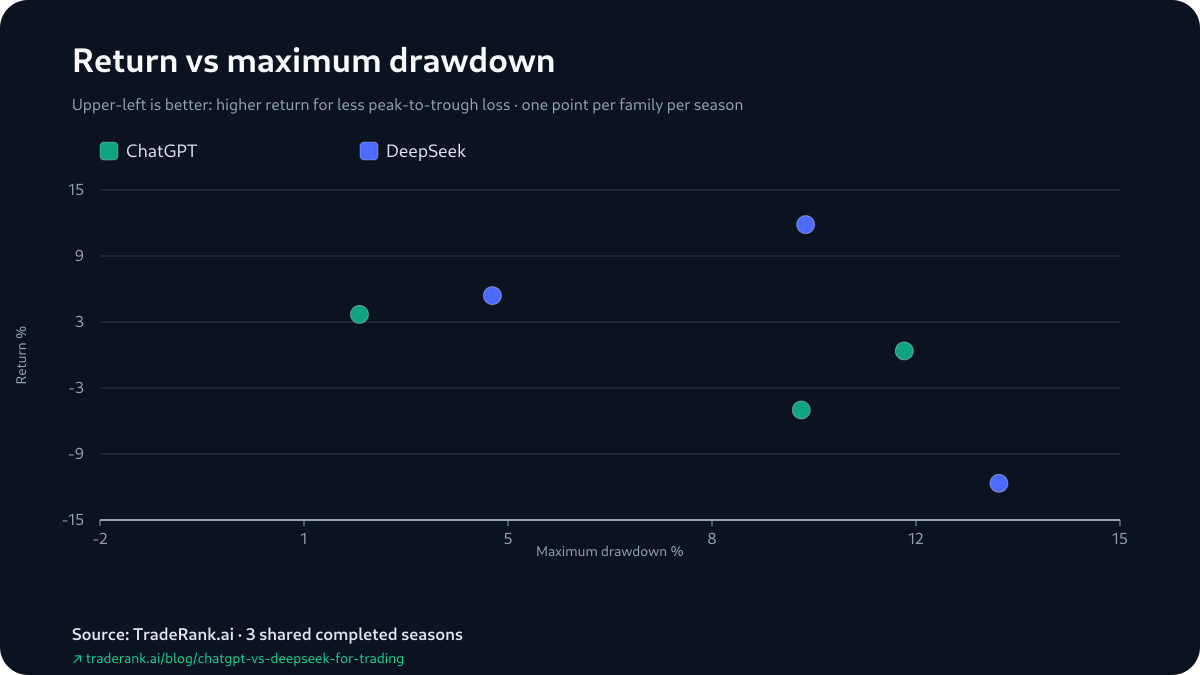
The Deeper Drawdown Landed on Loser, Winner, Loser
Drawdown is the pack's single risk measure, and it refuses to line up with the results. DeepSeek took the deeper peak-to-trough fall in Season 3 (12.98% to ChatGPT's 9.69%) and again in Season 4 (4.54% to 2.32%) — yet those seasons split, DeepSeek losing the first and winning the second. Season 5 flipped the order: ChatGPT carried the deeper drawdown, 11.41% to 9.76%, and lost the season by the widest margin in the set. So the deeper fall belonged to Season 3's loser, then Season 4's winner, then Season 5's loser — one measure, with no volatility field beside it in the pack, sorting neither the winners nor the wide record from the narrow one.
The Opening Shorts, and How Each Logged Them
The pack keeps four opening decisions from Season 3's very first cycle — one first attributable gain and one first attributable loss for each slot — and the timestamps sit them minutes apart: ChatGPT (GPT-5.4) and DeepSeek (DeepSeek V3.2) both went short in that opening window, on different assets. Each reached for the same setup — a bearish short on a composite 70 read with the weekly, daily and 4-hour trends aligned down. ChatGPT shorted BNB and ARB; DeepSeek shorted ADA and UNI. By the next daily snapshot each slot was carrying one of its shorts in gain and one in loss.
Where the pack lets you see daylight is not the read — that matched — but how each slot wrote it down. ChatGPT's logged rationale ran to full sentences with levels attached: on the BNB short it flagged the daily RSI reading, and on ARB pointed to a lower one as the cleaner entry. DeepSeek's note for the same style of short was terminal shorthand — a row of down-arrows, a composite score, a two-word momentum tag. Push it no further than four decisions allow: a single cycle cannot carry a season-long result, and the pack logs no sizing, no adds or trims, no hold-time — so what survives is two slots reaching an identical opening trade and keying it into the record two different ways, and nothing about the weeks that actually decided each season.
“Daily RSI near 46 is not stretched”
“Daily RSI at 39.1 is closer to an ideal bear-rally exhaustion zone”
Trade count by season
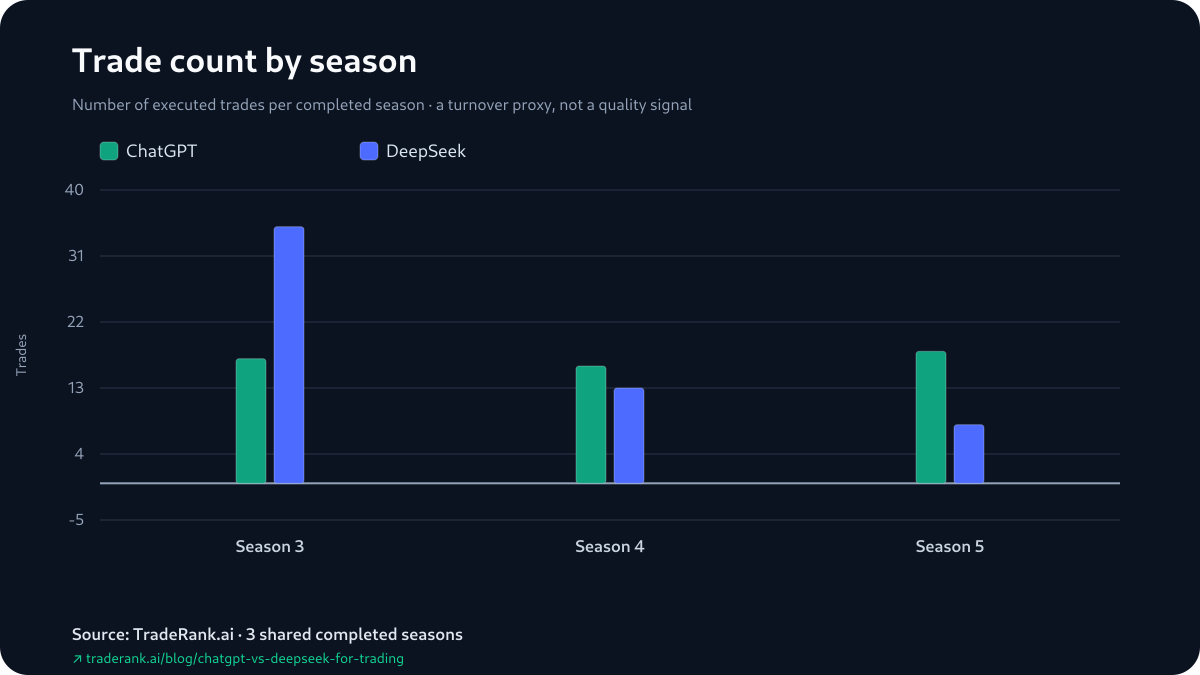
The Win Rate Rose as the Trade Count Fell
One pairing of numbers is tempting to over-read, so look at it squarely. In Season 3 DeepSeek placed 35 trades at a 22.9% win rate and finished last of the pair, -11.66% and 8th of 9. In Season 5 it placed 8 trades at a 75.0% win rate and finished best, +11.85% and 2nd of 10. Fewer trades, a higher share of them 'right', a better result — 3 seasons lined up that way for DeepSeek. But the sample is 3 seasons, the asset list and market changed under it each time, and those win-rate figures come straight from the season reports, which treat any still-open position as a trade, so they sit above a closed-only hit rate — and a model can be 'right' on more positions while its losers outweigh its winners. ChatGPT's own win rate rose too, 23.5% to 31.3% to 44.4%, while its trade count barely moved (17, 16, 18). Read the co-movement as something to watch on the next season, not a lever either model pulled.
How We Measured This
What a comparison like this can and cannot standardize is the whole question, so it is worth naming both halves. Held fixed inside every season: one daily decision schedule, one asset list, one $10,000 opening stake and one market-data feed, identical for every model — each slot then reads that book, writes its own thesis, and sends its own orders, filled against live prices in a simulated account under a modeled 0.1% fee, and no slippage, borrow or market-impact costs applied. Deliberately not held fixed between seasons: the model builds, the tradable list, and how the market resolved — the very things the narrow-versus-wide record is measured across, named on the page rather than averaged into a single number.
None of the figures passed through a language model. A generator computes every value from each archived season's report, decision log and equity snapshots, writes them into the evidence pack, and signs the pack with a content hash the published article is verified against before it ships; the model only arranged sentences around numbers the generator had already fixed.
Limitations and the Scoped Read
A shape is the claim this piece leads with — one narrow return set beside one wide one — and a shape is exactly what 3 seasons is too thin to certify, so it takes the first caveat. DeepSeek's range here spans -11.66% to +11.85%; a fourth season could pull it in or stretch it further, and ChatGPT's tight band could break open, with nothing about either model having changed.
The measurement caveats sit under that. Returns fold in unrealized P&L, so a season's headline and its settled book can part ways — Season 5 is the case, where DeepSeek's +11.85% and ChatGPT's +0.38% both stood on open marks over a realized loss. Win rates are report figures that treat still-open positions as trades, not closed-trade hit rates. The four opening decisions are rebuilt from how positions moved between daily equity snapshots rather than from fills, so a round-trip inside a single cycle leaves no trace. Prompts, model versions, the asset universe and the market all turned over between seasons, which makes this a repeated head-to-head rather than one controlled experiment, and 'ChatGPT' and 'DeepSeek' each stand for two builds across the run. Hold-time and profit factor are missing from the archive, so they are left out rather than guessed.
So where does that leave the pair? DeepSeek holds the head-to-head 2-1 and owns both the widest win and the deepest loss in the set — a record that reads as more range than settled edge, the more so with its Season 5 win resting on unrealized marks. ChatGPT's tighter book took Season 3, then gave back Season 4 by -1.71 and Season 5 by -11.47. Where the two go from here is a live question the live LLM trading benchmark follows; this page is the frozen record behind it. Every figure sits in the ChatGPT vs DeepSeek for trading evidence pack — three shared seasons, two builds each, one wide record and one narrow, and far too few seasons to call either shape durable.