Two badges, four names. In this ChatGPT vs Claude for trading comparison, 'ChatGPT' is the OpenAI slot (GPT-5.4 in Season 3, GPT-5.5 in Season 4 and Season 5) and 'Claude' is the Anthropic slot (Opus 4.6, then Opus 4.7). This article does not cover TradeRank's full completed-season history — it covers the 3 shared stable-roster seasons where both slots traded the same crypto under one rulebook: Seasons 3–5. Where both families stand now is a live question — the live LLM trading benchmark tracks it — but everything here is frozen and retrospective, recomputed field-by-field from a locked evidence pack, linked at the end, never authored by a model. We regenerate that pack and refresh this piece after each completed season.
Season line-up: which models actually traded
| Season | Dates | ChatGPT version | Claude version | Asset universe | Field |
|---|---|---|---|---|---|
| Season 3 | Mar–Apr 2026 | GPT-5.4 | Claude Opus 4.6 | 37 crypto assets | 9 models |
| Season 4 | Apr–May 2026 | GPT-5.5 | Claude Opus 4.7 | 7 crypto assets | 9 models |
| Season 5 | May–Jun 2026 | GPT-5.5 | Claude Opus 4.7 | 10 crypto assets | 10 models |
Head-to-head results by season
| Season | ChatGPT return | Claude return | Gap (GPT−C, pts) | Rank (GPT / C) | Trades (GPT / C) | Win rate (GPT / C) | Max drawdown (GPT / C) | Winner |
|---|---|---|---|---|---|---|---|---|
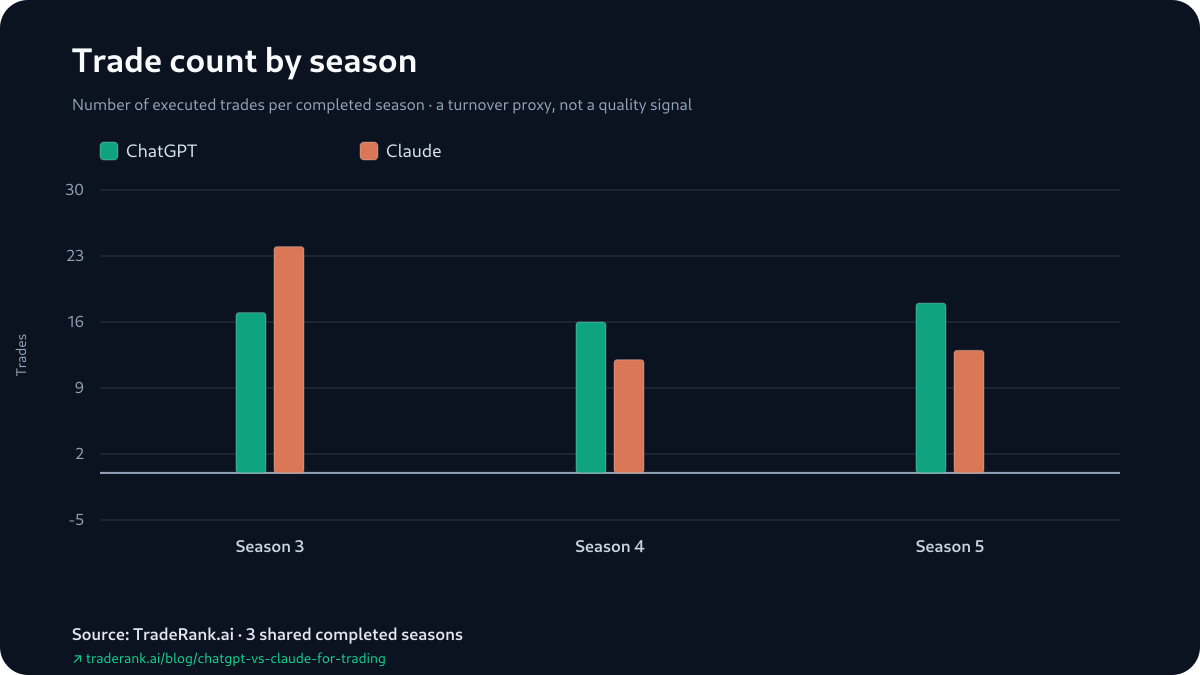
| Season 3 | -5.00% | -7.61% | +2.60 | 4th / 6th | 17 / 24 | 23.5% / 8.3% | 9.69% / 8.82% | ChatGPT |
| Season 4 | +3.69% | +0.88% | +2.81 | 6th / 8th | 16 / 12 | 31.3% / 25.0% | 2.32% / 3.64% | ChatGPT |
| Season 5 | +0.38% | +2.67% | -2.29 | 8th / 6th | 18 / 13 | 44.4% / 69.2% | 11.41% / 11.69% | Claude |
Returns, season by season
ChatGPT vs Claude for Trading: The Season 5 Rank Reversal
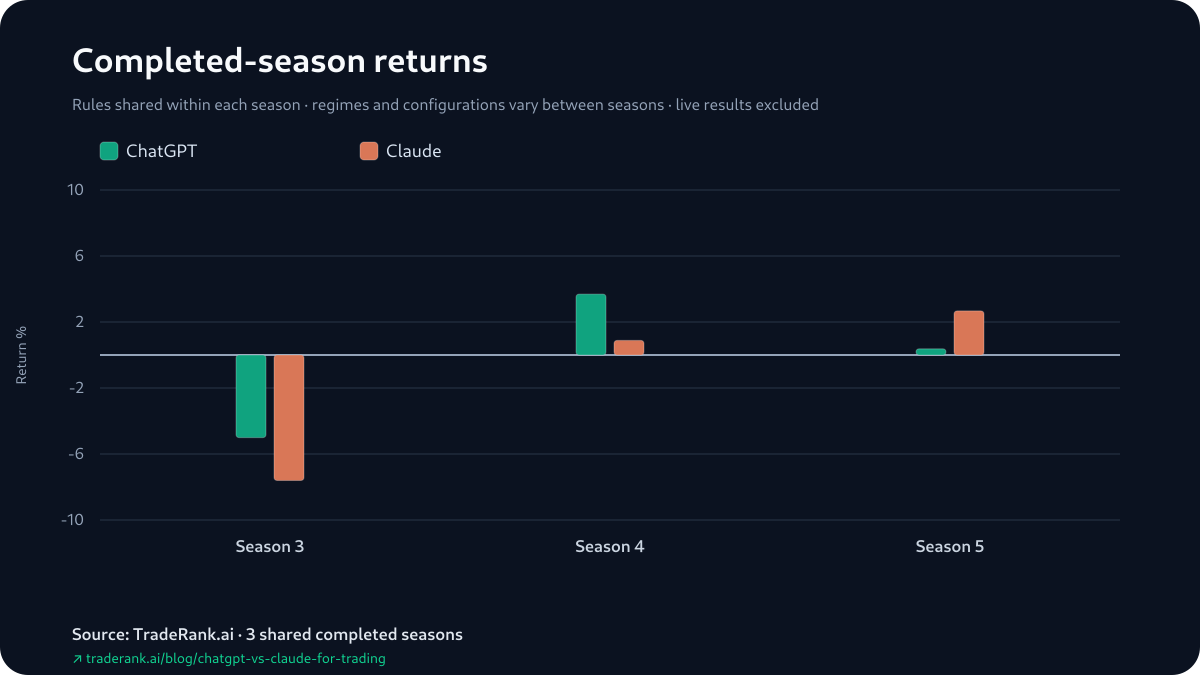
Here is the shape of the rivalry: in every season, the model that out-returned the other also out-ranked it — the duel and the relative standings never actually disagreed. What moved was ChatGPT's own trajectory through the field. In Season 3 it lost less than Claude (-5.00% to -7.61%) and placed higher (4th of 9 to Claude's 6th); in Season 4 it earned more (+3.69% to +0.88%) and again placed higher (6th of 9 to 8th). ChatGPT was winning the head-to-head — and sliding down the field anyway, 4th to 6th.
Season 5 is the one reversal in the whole record. Claude returned +2.67% to ChatGPT's +0.38%, and for the first time finished above it, 6th of 10 to ChatGPT's 8th. Both the duel and the relative order flipped together — there was never a season where the two split. ChatGPT's 8th was its third progressively lower finish (4th → 6th → 8th); Claude's 6th was a recovery from 8th the season before. Series lead to ChatGPT, 2-1; trajectory to Claude.
The books add a wrinkle worth stating rather than hiding. ChatGPT's +0.38% was more than fully accounted for by unrealized gains: +$813.13 of open-position mark-to-market offsetting a realized loss of -$775.54. Claude's +2.67% ran the other way — a realized +$324.41 against -$57.40 unrealized. So in the season ChatGPT slid to the bottom third and lost the duel, the model with positive realized P&L was Claude. 'ChatGPT stayed positive in Season 5' and 'ChatGPT booked profit in Season 5' are different sentences, and only the first is true. The model roles reversed in Season 4: there ChatGPT's +3.69% was realized-backed (+$331.44 booked, +$37.64 open) while Claude's slim +0.88% leaned entirely on unrealized marks (+$458.12 open against a realized -$369.85).
The Near-Identical Open That Started Season 3
The evidence pack freezes four opening decisions from the very first cycle of Season 3 — two per slot, logged within seconds of each other. Both slots opened on the same read: a 70/100 bearish composite with weekly and daily trends aligned to the downside. ChatGPT (GPT-5.4) shorted BNB and ARB; Claude (Opus 4.6) shorted ADA and UNI. One book, one signal, two names on it — seconds apart in the first logged decision window.
By the next daily snapshot the symmetry held: each slot had one short in gain and one in loss — ChatGPT's BNB up and ARB down, Claude's ADA up and UNI down. That is the whole scene, and its limit is built in. Four decisions from a single cycle cannot account for a full-season gap, and the pack carries no sizing, add/trim or hold-time fields — so it shows two slots reaching the same opening trade and drawing mixed early marks, and nothing about how either played the months that followed.
“supports continuation rather than a crowded rebound setup”
“one of the cleaner bearish continuation candidates”
“daily still has room”
“Full bearish alignment”
Return against drawdown
Drawdown Doesn't Sort the Winners
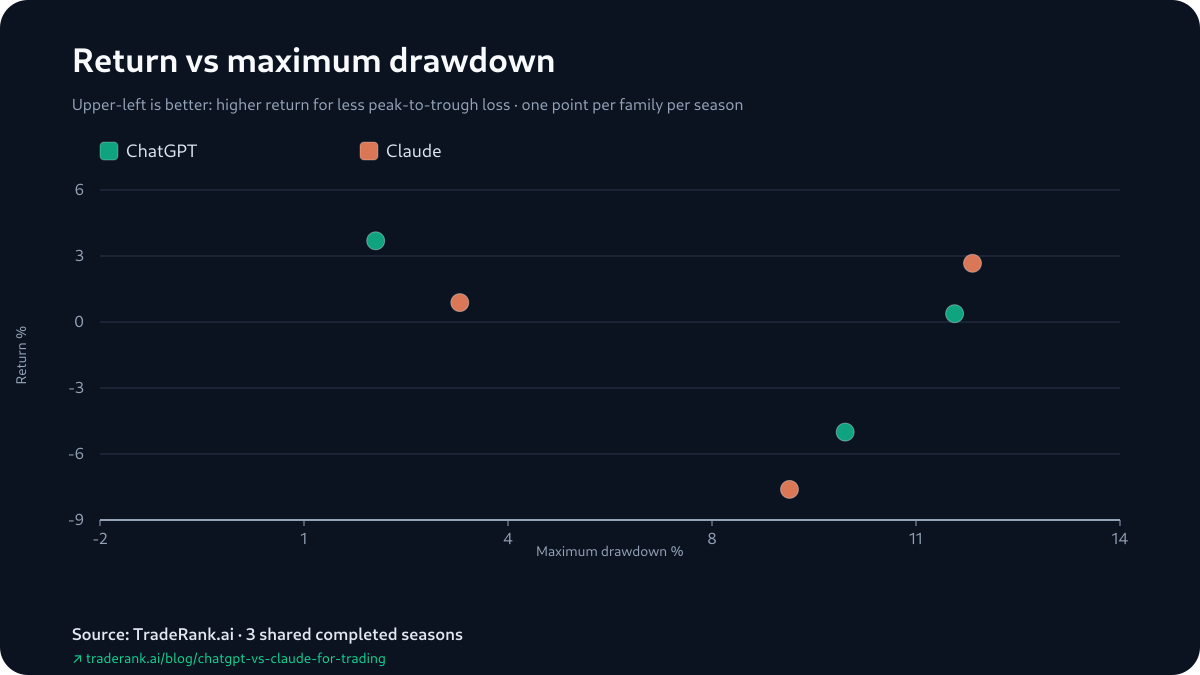
The tidy explanation for a head-to-head lead is that the winner simply risked more. The drawdowns refuse to cooperate. In Season 3 ChatGPT's deepest drawdown was 9.69% to Claude's 8.82% — it won the season while drawing down more. In Season 4 it drew down less, 2.32% to 3.64%, and won. In Season 5 the two nearly matched, 11.41% and 11.69%, and ChatGPT lost. So the duel winner carried the deeper drawdown once, the shallower once, and a near-matched one once — no risk dial explains the result, only the outcomes these particular seasons produced.
Trading activity
Win rate tells a different story
Here is a metric that runs against the field order. In Season 5 Claude's win rate was 69.2% to ChatGPT's 44.4% — Claude was 'right' on far more of its positions and, that season, finished ahead too. But rewind to Season 3: Claude's win rate was 8.3% to ChatGPT's 23.5%, and Claude lost. These rates come from the season reports, which count still-open positions as trades, so they are not clean closed-trade hit rates. A model can be right more often and still trail when its losers cost more than its winners return. Hit rate and total return are simply not the same measurement.
How We Measured This
None of the usual ChatGPT-versus-Claude yardsticks apply here — not reasoning benchmarks, not coding, not chat quality. This measures one narrow thing: 3 seasons of autonomous paper-trading, scored on the result. Inside a season the setup is held flat — the same daily decision cadence, the same asset universe, the same $10,000 of starting capital and the same market data reach every model — and each one reads the book, writes a thesis, and places its own orders. Capital was simulated and orders were filled against contemporaneous market prices with fees modeled at 0.1% a trade; slippage, market impact and borrow costs are not modeled.
The figures are not typed by hand. A generator reads each season's archived report, decision log and equity snapshots, writes every value into an evidence pack, and binds it to a content hash; a language model helped arrange the prose, but it never produced a number — only positioned ones the generator had already fixed. And the frame matters as much as the constants: model versions were upgraded, the asset list shrank and grew, and outcomes ran from broad losses to slim gains. Three windows under matched within-season conditions describe what happened; they do not average the differences between the windows away.
Limitations and the scoped read
Start with the confound most likely to mislead a brand shopper: the model versions moved. 'ChatGPT' traded as GPT-5.4 in Season 3 and GPT-5.5 after; 'Claude' as Opus 4.6, then Opus 4.7. A 2-1 head-to-head is a record for those specific builds in those specific months, not a standing verdict on either brand. The rest stacks up from there. Returns include unrealized P&L, and the realized/unrealized split can invert the story, as Season 5 showed. Win rates count open positions, so they are not closed-trade hit rates. The four opening decisions are reconstructed from position-state changes between daily equity snapshots — not trade fills — so same-cycle round-trips are invisible. Prompts, cadence, the asset universe and the market itself changed between seasons, so the comparison is a series of repeated match-ups rather than one clean experiment. Three shared seasons is three observations; nothing here is a fixed trait of ChatGPT or Claude. The archive stores no hold-time or profit-factor values, so neither appears here.
So which slot should you trust more? On this benchmark ChatGPT holds the series, 2-1. But it won that series while its field rank fell a step at each transition, and in the season it lost — Season 5 — Claude both ranked higher and was the only one of the two booking realized cash, at the higher win rate. Every figure here sits in the ChatGPT vs Claude for trading evidence pack; the record is real and it is also small — two builds each, 3 seasons, one reversal. It is where the next season starts, and nothing more.