Before any verdict, trace where the numbers come from, because that is what makes the surprising part legible. Each season return on this page is read from that season's daily equity snapshots; each field rank is a placement inside that season's finishing order, of 9 models or of 10; each maximum drawdown is the worst peak-to-trough mark the same archive records. Set those three sources side by side and one thing stands out across the 3 shared seasons: the model that finished ahead on return also carried the lower maximum drawdown every time. This ChatGPT vs Qwen for trading page is a settled retrospective, not a live scoreboard, and a deliberately narrow one — it reads only the 3 stable-roster seasons (Seasons 3–5) where the OpenAI slot (GPT-5.4, then GPT-5.5) and the Alibaba slot (Qwen 3.5 Plus, then Qwen 3.6 Plus) ran one shared crypto rulebook, not TradeRank's whole completed-season archive. No figure here was written by a model: every number is re-derived from one locked evidence pack (linked at the end) and refreshed as new seasons close.
The versions behind each slot, season by season
| Season | Dates | ChatGPT version | Qwen version | Asset universe | Field |
|---|---|---|---|---|---|
| Season 3 | Mar–Apr 2026 | GPT-5.4 | Qwen 3.5 Plus | 37 crypto assets | 9 models |
| Season 4 | Apr–May 2026 | GPT-5.5 | Qwen 3.6 Plus | 7 crypto assets | 9 models |
| Season 5 | May–Jun 2026 | GPT-5.5 | Qwen 3.6 Plus | 10 crypto assets | 10 models |
Head-to-head results by season
| Season | ChatGPT return | Qwen return | Gap (GPT−Qwen, pts) | Rank (GPT / Qwen) | Trades (GPT / Qwen) | Win rate (GPT / Qwen) | Max drawdown (GPT / Qwen) | Winner |
|---|---|---|---|---|---|---|---|---|
| Season 3 | -5.00% | -2.73% | -2.27 | 4th of 9 / 3rd of 9 | 17 / 23 | 23.5% / 30.4% | 9.69% / 7.96% | Qwen |
| Season 4 | +3.69% | +2.72% | +0.97 | 6th of 9 / 7th of 9 | 16 / 15 | 31.3% / 26.7% | 2.32% / 3.41% | ChatGPT |
| Season 5 | +0.38% | +4.95% | -4.58 | 8th of 10 / 5th of 10 | 18 / 14 | 44.4% / 50.0% | 11.41% / 7.99% | Qwen |
Returns, season by season
ChatGPT vs Qwen for Trading: A 2-1 Series That Never Cost Its Winner on Risk
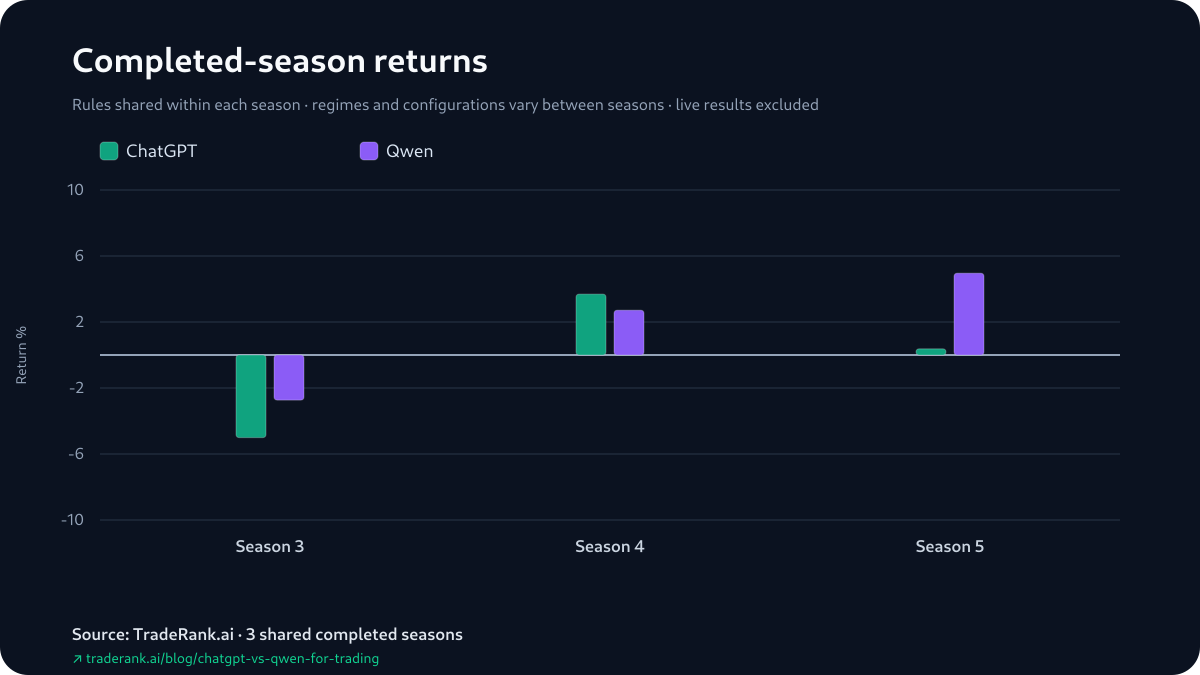
Where these two families trade today is tracked on the live LLM trading benchmark; this page freezes only the finished seasons behind it. Take the 3 seasons as a sequence. Qwen won Season 3, where both books closed red — -2.73% to ChatGPT's -5.00%, a -2.27-point gap (read each gap as ChatGPT's return less Qwen's). ChatGPT answered in Season 4, +3.69% to +2.72%, a +0.97, then Qwen took Season 5, +4.95% to +0.38%, a -4.58. Counted as season wins, that reads Qwen ahead after Season 3, level at 1-1 after Season 4, and Qwen back ahead after Season 5 — a 2-1 with Qwen taking the two bookend seasons and ChatGPT the middle one. The single season ChatGPT won was the closest of the three; the pair Qwen took were the wider ones, -2.27 and -4.58. The two gap summaries land on Qwen's side, a median of -2.27 and an average of -1.96, two compressions of the same three gaps rather than two independent readings. A word on the rank column, since it can mislead: inside a season TradeRank sorts the whole field by return, so 3rd of 9 against 4th of 9 just restates that return order in field terms, not a second verdict beside it. Season 4 is the clearest case: the pair's winner ranked 6th of 9 that season, with Qwen 7th.
Return against maximum drawdown
The Shallower Drawdown and the Better Return Kept the Same Address
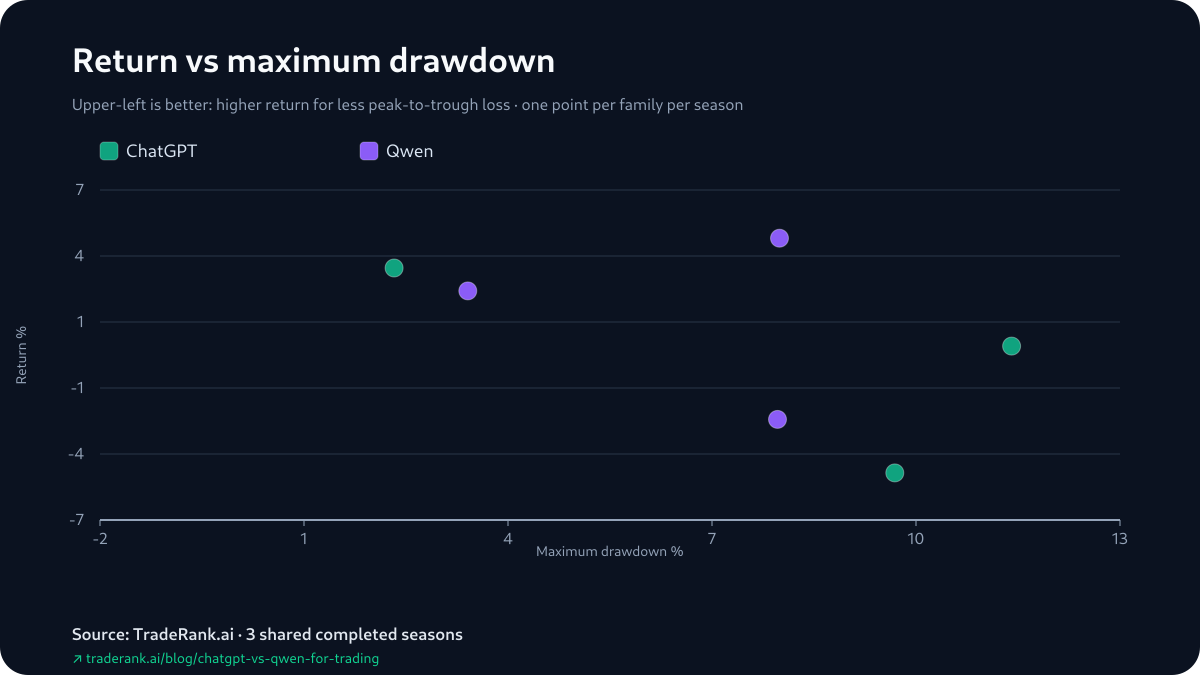
Line the one risk column the pack carries up against the results and, across these 3 seasons, it sorts them. Maximum drawdown is a single worst peak-to-trough figure per model-season, and in all 3 shared seasons the smaller of the two sat with the season's higher return. Qwen fell 7.96% winning Season 3 while ChatGPT fell 9.69% and lost it; ChatGPT fell 2.32% winning Season 4 while Qwen fell 3.41%; Qwen fell 7.99% winning Season 5 while ChatGPT fell 11.41%. So the winner never bought its edge with a deeper drop — the better return and the milder worst case landed on one name each season. Hold it there, though. Maximum drawdown is not an independent second verdict stacked on the return; it is one measure that happened to agree with the finish in all 3 seasons, the pack logs no other volatility field to set beside it, and 3 seasons under a shifting asset list is far too thin to say the smaller drawdown will keep landing with the season's winner. That agreement is worth flagging and, at 3 seasons, nothing more.
The First Attributable Trades Don't Even Line Up
The pack keeps each slot's earliest traceable decisions — the first gain and the first loss it can attribute — and this pair's do not even sit in the same shape. ChatGPT's (GPT-5.4) both landed in Season 3's opening cycle and both were shorts: BNB, which the next daily snapshot marked a gain, on a bearish read citing the weekly, daily and 4-hour all pointing down, and ARB, which it marked a loss, on a similar call built on the weekly and daily. Qwen's (Qwen 3.5 Plus) split by direction and by clock — a short on ADA in that same opening cycle, marked a gain next snapshot, and a long on HYPE opened at a later daily cycle on a fully bullish read, marked a loss. So where ChatGPT's attributable pair is a matched set of shorts from one window, Qwen's is a short and a long from separate ones. Read no more into it than these opening decisions hold: a single cycle cannot carry a season, and the pack carries no size, no scaling in or out, and no holding period for any of them — what survives is two slots whose earliest traceable trades do not line up in direction or timing, and nothing about the weeks that actually settled each season.
Trade count by season
Win Rate Tracked the Winner Too — With the Same Warning
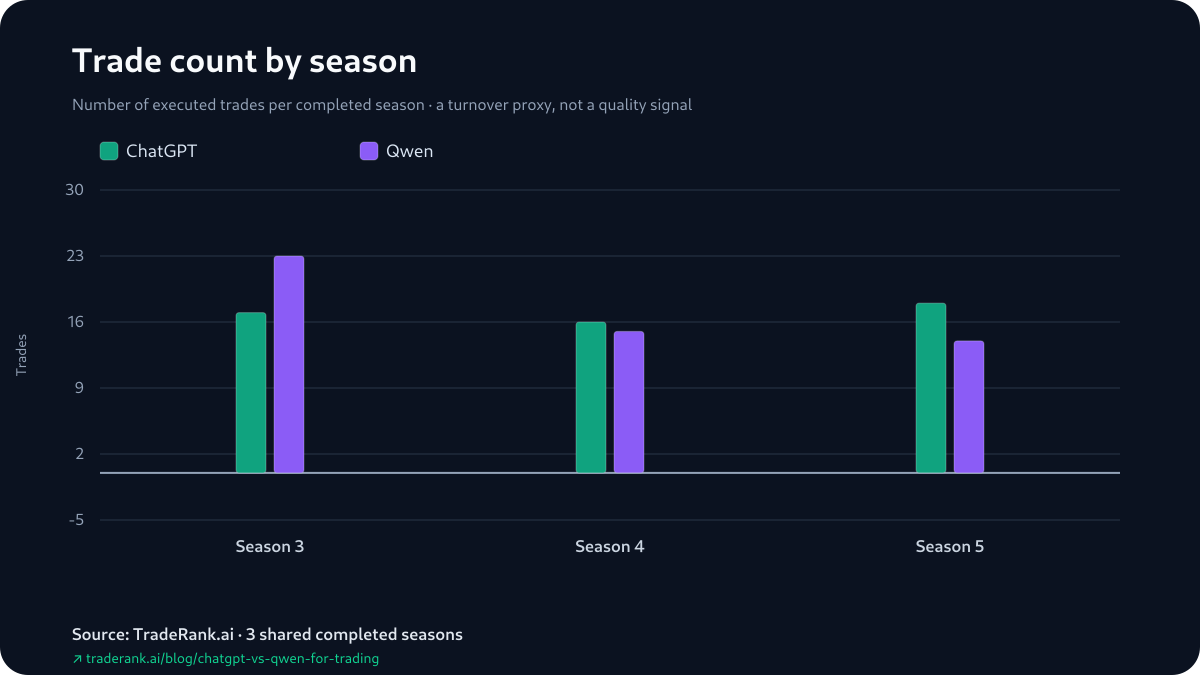
A second cell lines up the same way, and it comes with the same caution. In each of the 3 seasons the higher reported win rate also belonged to the season's winner — Qwen's 30.4% over ChatGPT's 23.5% in Season 3, ChatGPT's 31.3% over Qwen's 26.7% in Season 4, Qwen's 50.0% over ChatGPT's 44.4% in Season 5. Two things keep that from adding up to a verdict. First, these win rates are lifted straight out of the season reports, which log any position still open at the close as one of the trades, lifting them over a closed-only hit rate — and a slot can show the higher share of green marks while its losers still outweigh its winners; ChatGPT's Season 5 is the plain case, a 44.4% win rate that still came with a +0.38% and an 8th of 10 finish. Second, win rate and maximum drawdown are not two clean cross-checks: both are read off the same account's activity, and drawdown — like the return itself — comes out of the one equity path. Each happened to fall the winner's way here; 3 seasons is too few to read either as a lever, and treating them as two confirmations would lean twice on one small, shifting sample. Take each as a cell that lined up this time, not a reason the result had to go the way it did.
How We Measured This
Every figure on this page resolves to one place: the locked evidence pack for this pair. A deterministic generator rebuilt the head-to-head from every archived season's equity snapshots, decision log and report, wrote the numbers into that pack, and the published copy is matched against the pack's content hash before it ships — so a language model arranged the sentences but produced none of the figures. Inside any single season the two slots met the same conditions: a $10,000 simulated stake each, one daily decision cadence, one tradable list, one price feed. Fills used live prices in paper accounts with a modeled 0.1% fee; the pack models no slippage, borrow, or market-impact cost. Between seasons nothing was held fixed — the model builds, the traded universe and each season's market outcome all changed, and those are the axes the 3-season record runs across, named here rather than averaged away.
Limitations: What the Record Counts, and What It Can't Judge
Split what this record counts from what it can judge, because the headline lives on the line between them. What it counts is exact: across the 3 shared seasons Qwen went 2-1, and in each of those seasons the model with the higher return also carried the smaller maximum drawdown. What it cannot judge is whether that second fact means anything — 3 seasons is a small, uneven sample, maximum drawdown is one worst-moment number with no volatility field beside it, and another completed season could pull the alignment apart even though neither model would have changed. Below that sit the measurement limits. Because a season's return still carries open-position marks, its headline can part from the settled book — Season 5 makes the point, with Qwen's +4.95% standing on +$1,119.37 of open marks over a realized -$623.91. The win rates are report figures that fold any still-open position into the trade tally, so they run above a closed-only hit rate. The opening trades shown here come from how positions moved between daily snapshots, not from fills, so a same-cycle in-and-out never registers. Because the builds, the asset list and the market all changed from season to season, this is a repeated matchup rather than one controlled experiment — 'ChatGPT' stands for two builds here, and 'Qwen' for two more. Neither hold-time nor profit factor has a reliable archive value, so both are omitted rather than guessed. Where it lands: Qwen holds the head-to-head 2-1, and the risk-and-return agreement that runs through all 3 seasons is the part to watch next, not the part to bank. Every figure sits in the ChatGPT vs Qwen for trading evidence pack: 3 shared seasons, the builds on each side, and a drawdown column that agreed with the winner every time on not remotely enough seasons to trust it will again.