Search for a ChatGPT vs MiniMax for trading comparison and the measured part is missing — we could not find a season-by-season, shared-market head-to-head for this specific pair anywhere. This page sets one down. (MiniMax here is the trading model from the AI company MiniMax — its MiniMax M2 line — not the minimax search algorithm the name also brings to mind.) What follows is a frozen back-look at finished seasons, and a deliberately narrow one. Rather than TradeRank's whole run of finished seasons, it reads only the 3 in which OpenAI's slot — GPT-5.4, later GPT-5.5 — and MiniMax's slot — MiniMax M2.5, later MiniMax M2.7 — sat in the same field on the same crypto under one rulebook — Seasons 3–5. The site's homepage ranks every model over more seasons at once; this page trades that breadth for depth on the single pair. Every number is regenerated straight from a hashed evidence pack — linked below — with nothing on the page written by a model; that pack is rebuilt and this piece re-checked as each new season closes.
Which builds actually traded each season
| Season | Dates | ChatGPT version | MiniMax version | Asset universe | Field |
|---|---|---|---|---|---|
| Season 3 | Mar–Apr 2026 | GPT-5.4 | MiniMax M2.5 | 37 crypto assets | 9 models |
| Season 4 | Apr–May 2026 | GPT-5.5 | MiniMax M2.7 | 7 crypto assets | 9 models |
| Season 5 | May–Jun 2026 | GPT-5.5 | MiniMax M2.7 | 10 crypto assets | 10 models |
Head-to-head results, season by season
| Season | ChatGPT return | MiniMax return | Gap (GPT−MM, pts) | Rank (GPT / MM) | Trades (GPT / MM) | Win rate (GPT / MM) | Max drawdown (GPT / MM) | Winner |
|---|---|---|---|---|---|---|---|---|
| Season 3 | -5.00% | -0.63% | -4.37 | 4th of 9 / 1st of 9 | 17 / 10 | 23.5% / 20.0% | 9.69% / 4.11% | MiniMax |
| Season 4 | +3.69% | +6.94% | -3.25 | 6th of 9 / 1st of 9 | 16 / 9 | 31.3% / 55.6% | 2.32% / 2.45% | MiniMax |
| Season 5 | +0.38% | -8.05% | +8.43 | 8th of 10 / 10th of 10 | 18 / 8 | 44.4% / 37.5% | 11.41% / 8.90% | ChatGPT |
Returns by season
ChatGPT vs MiniMax for Trading: One Ordering Survived Every Shared Season
Where these two stand in current form is a live matter the live LLM trading benchmark keeps; everything below this line is frozen. Read the 3 seasons as orderings that either held or moved.
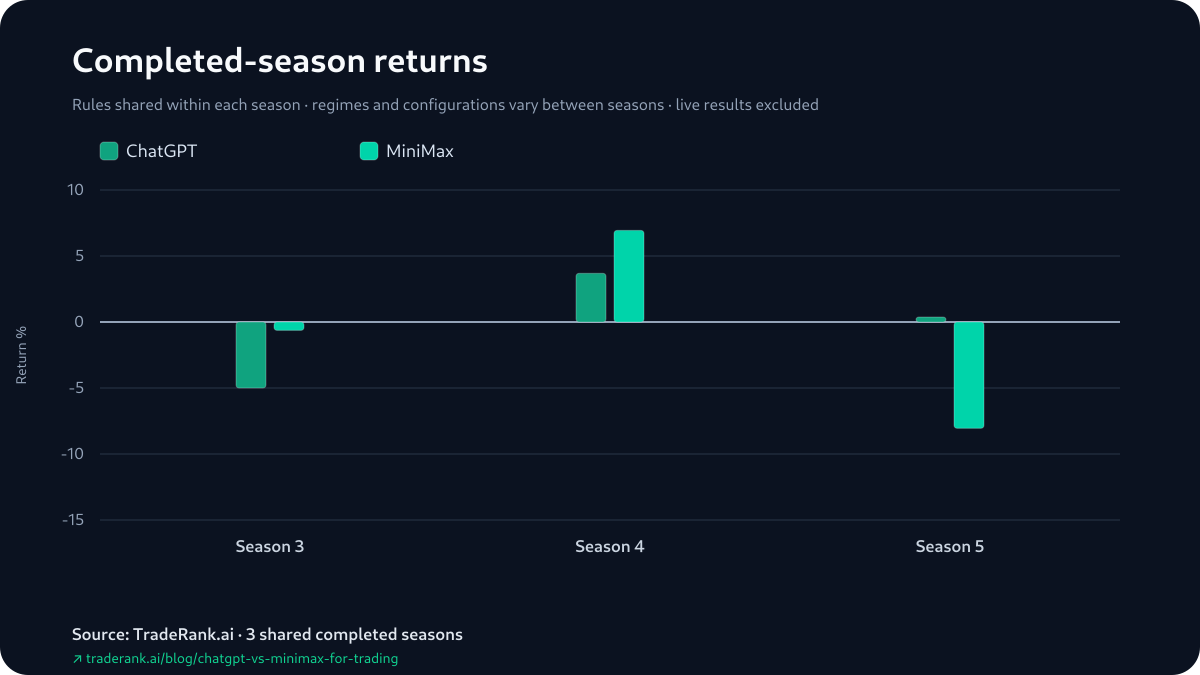
Take the results first. In Season 3 both books finished red and MiniMax finished less red — -0.63% to ChatGPT's -5.00%, a -4.37-point gap (every gap on this page is ChatGPT minus MiniMax) — and it did so from the front of the field, 1st of 9 to ChatGPT's 4th. Season 4 kept the same direction with both green: MiniMax +6.94% and again 1st of 9, ChatGPT +3.69% and 6th of 9, a -3.25 gap. Then Season 5 turned the order over: ChatGPT +0.38% and 8th of 10, MiniMax -8.05% and 10th of 10, a +8.43 gap the other way. Field rank is a deterministic function of each season's return, so rank and return are one axis read from two ends, not two verdicts — and that single axis changed the order between these two exactly once, after Season 4.
Play the season wins in sequence and MiniMax stays in front the whole way: it took Season 3, then Season 4, so it led both it had played; ChatGPT's Season 5 win made the series 2-1 without ever pulling MiniMax back. The 3 gaps, set side by side, are -4.37, -3.25 and +8.43; their median is -3.25 and their average +0.27, the average landing near flat because Season 5's single wide gap pulls against MiniMax's two narrower ones.
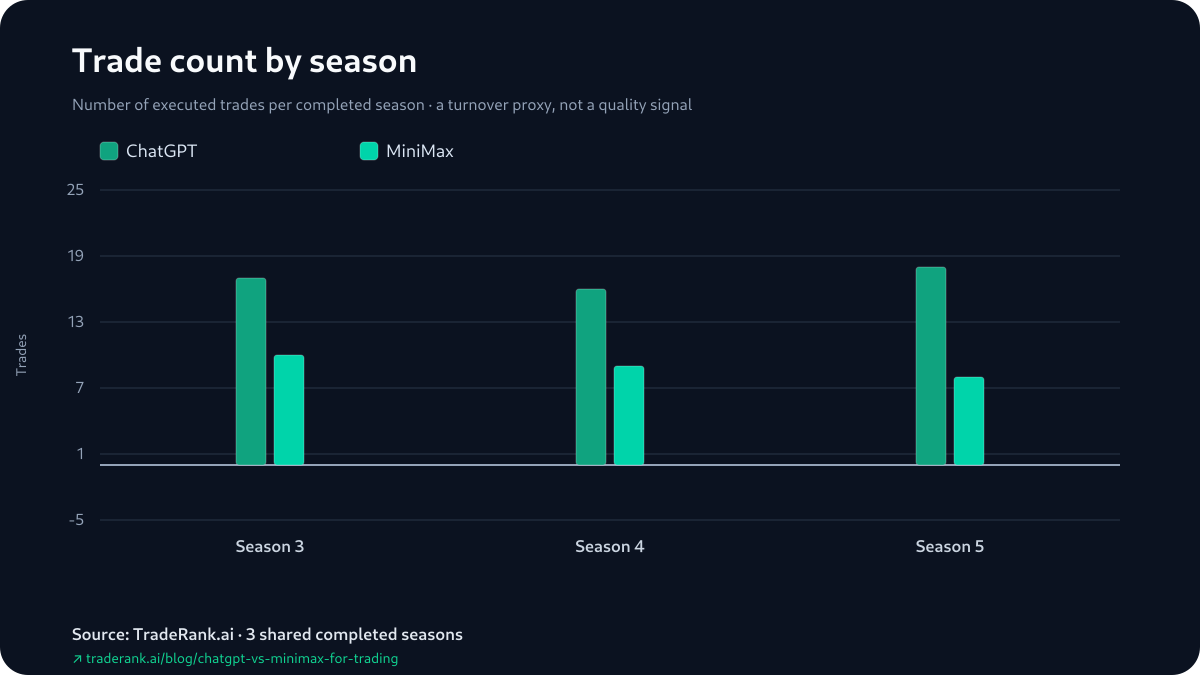
Win rate moved differently again. ChatGPT's rose season over season while MiniMax's ran 20.0%, up to 55.6%, back down to 37.5%; the higher win rate belonged to ChatGPT in Season 3, to MiniMax in Season 4, and to ChatGPT again in Season 5. Maximum drawdown, the pack's one risk column and drawn off the same equity path as the return, reordered too. Across all of it, a single column keeps one order start to finish: ChatGPT logged more trades than MiniMax in every season. That is the observation this pair leaves — not who is better, but that on 3 shared seasons the only thing that stayed put was which slot traded more.
Trade count by season
The Column That Never Changed Hands
Line the trade counts up and the order does not move: 17 to 10 in Season 3, 16 to 9 in Season 4, 18 to 8 in Season 5, ChatGPT ahead each time. ChatGPT's counts sat at 17, 16 and 18; MiniMax's stepped down 10, 9, 8. It is the only measured column whose ordering between the two holds across all 3 seasons.
Say only what that is. On 3 shared seasons the busier slot was ChatGPT every time — a description of these 3 seasons, not a standing feature of either model; a fourth season with a different tradable list could close the gap or widen it. And the column decided nothing by itself: the more-active slot finished ahead in 1 season of the 3 and behind in the other 2, so activity kept its order while the results went their own way. The trade count is where these two records differ most cleanly; the outcomes are where they refuse to.
Reading Each Green Number Against Its Settled Book
A season's return, the way the standings publish it, values open positions at whatever the market last marked them, so the headline and the banked cash can part company — and MiniMax's 2 wins were built unlike each other on exactly that axis. Season 3 it won by losing least: a -0.63% that came to a -$63.39 total, -$50.40 of it realized and -$12.99 in open marks, best of a field where everyone finished down. Season 4 it won outright and settled: +6.94% was a +$693.93 total with both halves positive, +$447.24 realized under a +$246.69 open mark.
ChatGPT's numbers lean the other way in the season it won. Its Season 5 +0.38% was a +$37.59 total resting entirely on +$813.13 of open marks over a realized -$775.54 — the position book was down on settled trades and green only on exposure still live at the close. MiniMax's own Season 5 marks could not save it: +$41.13 open against a realized -$846.45, a -$805.32 total and last of 10. None of that unwinds a result — a live mark is a real gain the day it is read, and both books are simulated regardless — but it says the single season ChatGPT led was carried on open positions, and the 2 seasons MiniMax led were not assembled the same way as each other.
Return against maximum drawdown
The Drawdown Order Flipped Too
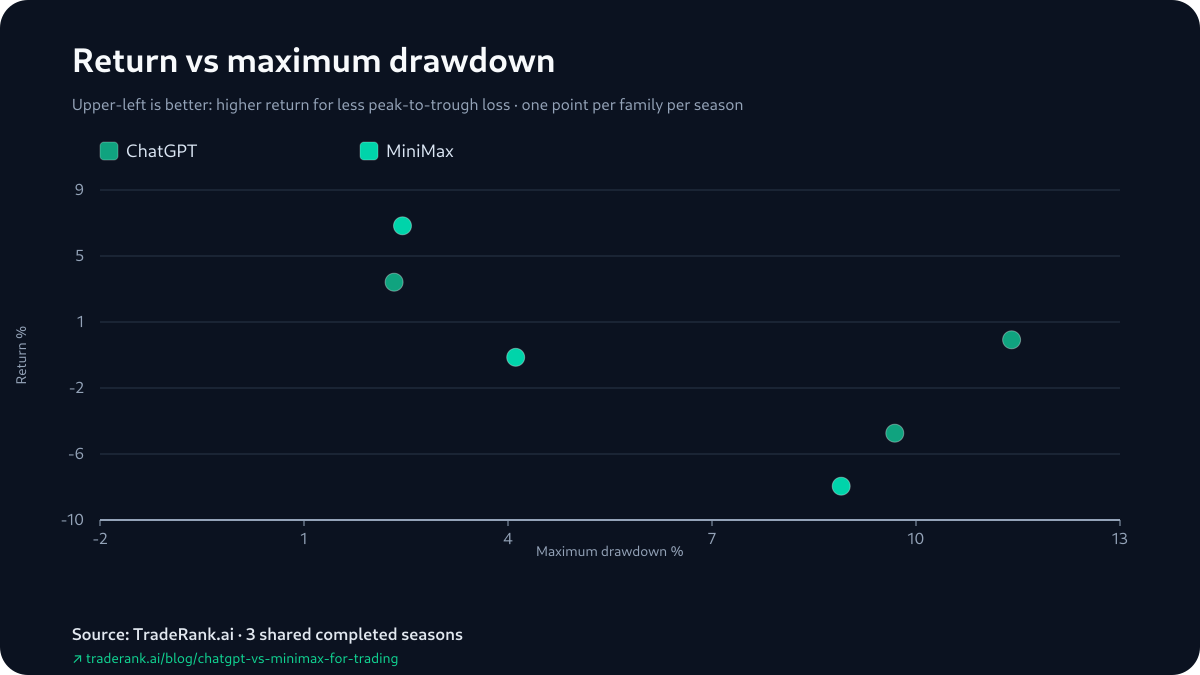
Drawdown, the pack's single risk figure, comes off the same equity path as the return, so it is one more read on that path rather than a fresh measure. It still refuses to sort the winners. MiniMax took the shallower peak-to-trough fall in Season 3, 4.11% to ChatGPT's 9.69%, and again in Season 5, 8.90% to 11.41% — but those 2 seasons split, MiniMax winning the first and losing the last. Season 4 nudged the order the other way, ChatGPT 2.32% to MiniMax's 2.45% — and with returns of +3.69% against +6.94%, it was the season the two ran closest on both counts. The shallower fall bought a win exactly once, MiniMax's 4.11% in Season 3; ChatGPT's 2.32% in Season 4 and MiniMax's 8.90% in Season 5 each belonged to that season's losing model. Drawdown depth sorted nothing here.
The Opening Decisions: One Setup, Different Names
Since this is the first measured record of the pair, its earliest entries deserve to be set down exactly. The pack preserves 4 opening decisions from Season 3 — for each slot, the earliest move it can tie to a gain and the earliest it can tie to a loss — and they catch both models shorting into the same bearish setup while never touching the same coin. In the opening 2026-03-23 cycle ChatGPT (GPT-5.4) shorted BNB, with the weekly, daily and 4-hour trends aligned down, and ARB, where its note rested on the weekly and daily reads; the next daily snapshot marked the BNB short a gain and the ARB short a loss. MiniMax (MiniMax M2.5) shorted ADA in that same first cycle for its marked gain; its marked loss arrived later, an ETH short opened 2026-03-27.
The notes behind those entries are the sharpest contrast the pack preserves. ChatGPT reasoned in prose, weighing each short against the risk of a rebound and citing the RSI level that made one entry cleaner than another. MiniMax filed the same class of call as a ticker line — direction, composite score, a momentum flag. Hold that at its true weight: 4 reconstructed decisions from an opening week, carrying no position size, no scaling in or out and no holding time, cannot speak for the weeks that settled each season. What they do preserve — for the first time side by side — is how differently the two slots talk to their own ledgers while acting on one read of the market.
“BEARISH 70/100”
“composite 70, negative funding”
MiniMax's Win Rate Peaked in a Win and Bottomed in a Lead
MiniMax's win-rate column refuses to line up with its finishes, so read it on its own. Its lowest of the 3, 20.0%, landed in Season 3 — the very season it ranked 1st of 9 and led the pair. Its highest, 55.6% in Season 4, also came in a win. And Season 5's 37.5% sat between the two while the return finished last of 10 at -8.05%. A share of positions 'right' and a place in the standings did not move together. One reason lives in the measurement: the season reports score a position still open at the close as a trade, so this is not a strictly closed-trade hit rate — and a slot can mark more positions green and still finish behind when the red ones run larger. ChatGPT's side is its own sequence: 23.5%, then 31.3%, then 44.4%, rising across a red result, a green one and a near-flat one. On 3 shared seasons, with the asset list changing under each, read the win-rate column as a figure to watch, not a lever either model pulled.
How We Kept Conditions Identical — and Where We Didn't
'Same conditions' is doing a lot of work in a comparison like this, so here is exactly what it covers and what it does not. Inside any single season, the rig is common to every model: a daily decision cadence, a fixed asset list, a $10,000 starting balance and a single price feed. Each slot then reads that shared book itself, forms its own thesis and issues its own orders; those fill at live prices inside a simulated account, charged a modeled 0.1% fee, with slippage, borrow and market-impact costs left out. What is not held fixed is everything between seasons: the model build, the tradable list, and how the market resolved. Those are the axes the reordering above is measured across, named here rather than blended into one average.
No figure on this page came from a language model. A generator re-issues every value from the archived report, the decision log and the equity snapshots of each season into a content-hashed evidence pack, and the published article is validated against that hash before it ships; the model only set sentences around numbers already fixed.
Limitations: What Would Move This Verdict
Start with what a fresh season could overturn. The load-bearing claim here is an ordering — trade count held while the standings did not — and a single column staying put across 3 seasons is exactly the kind of thing 3 seasons is too few to certify; a fourth in which MiniMax out-traded ChatGPT even once would soften the whole framing. The head-to-head itself is 2-1 on 3 games, close enough that a single season swings it.
The measurement caveats sit under that. Returns carry open-position marks, so a season's paper result and its booked cash can diverge — Season 5 shows it for both, each in the green or near it on marks while realized was negative. The win-rate figures come from the reports, which score any open position as a trade — so they are not a closed-only hit rate. The 4 opening decisions are reconstructed from the day-to-day change in each position between equity snapshots, not from order fills, so an intraday round-trip vanishes. Between seasons, meanwhile, almost nothing held still — the tradable list, the market's direction, the builds behind each slot ('ChatGPT' stands for GPT-5.4 then GPT-5.5, 'MiniMax' for MiniMax M2.5 then MiniMax M2.7), even the prompts — so this is a head-to-head run several times over rather than a single controlled experiment. Hold-time and profit factor are not in the archive, so they are left out rather than guessed.
Set against all that, what stands: MiniMax holds the head-to-head 2-1, winning Seasons 3 and 4 from the front of the field and losing Season 5 last of 10; ChatGPT's lone win, Season 5, was carried on open marks; and across all 3, the single ordering that never changed hands was which slot traded more. Every figure sits in the ChatGPT vs MiniMax for trading evidence pack — 3 shared seasons, 2 builds a side, and one activity gap that outlasted every result it sat beside.