ChatGPT and Grok get compared constantly — mostly on personality, screenshots and real-time-feed claims. This ChatGPT vs Grok for trading comparison measures the matchup on a ledger instead. It does not cover TradeRank's full completed-season history — only the 3 shared seasons where the OpenAI slot (GPT-5.4, then GPT-5.5) and the xAI slot (Grok 4.20, then 4.20 MA, then Grok 4.3) traded the same crypto under one rulebook: Seasons 3–5. Every figure is recomputed field-by-field from a locked evidence pack — linked at the end — and no number here was authored by a model; we regenerate that pack and refresh this piece after each completed season.
Season line-up: which versions actually traded
| Season | Dates | ChatGPT version | Grok version | Asset universe | Field |
|---|---|---|---|---|---|
| Season 3 | Mar–Apr 2026 | GPT-5.4 | Grok 4.20 | 37 crypto assets | 9 models |
| Season 4 | Apr–May 2026 | GPT-5.5 | Grok 4.20 MA | 7 crypto assets | 9 models |
| Season 5 | May–Jun 2026 | GPT-5.5 | Grok 4.3 | 10 crypto assets | 10 models |
Head-to-head results by season
| Season | ChatGPT return | Grok return | Gap (GPT−G, pts) | Rank (GPT / G) | Trades (GPT / G) | Win rate (GPT / G) | Max drawdown (GPT / G) | Winner |
|---|---|---|---|---|---|---|---|---|
| Season 3 | -5.00% | -15.90% | +10.90 | 4th of 9 / 9th of 9 | 17 / 22 | 23.5% / 27.3% | 9.69% / 19.72% | ChatGPT |
| Season 4 | +3.69% | +5.34% | -1.65 | 6th of 9 / 3rd of 9 | 16 / 18 | 31.3% / 16.7% | 2.32% / 7.34% | Grok |
| Season 5 | +0.38% | +0.48% | -0.11 | 8th of 10 / 7th of 10 | 18 / 15 | 44.4% / 46.7% | 11.41% / 7.27% | Grok |
Returns, season by season
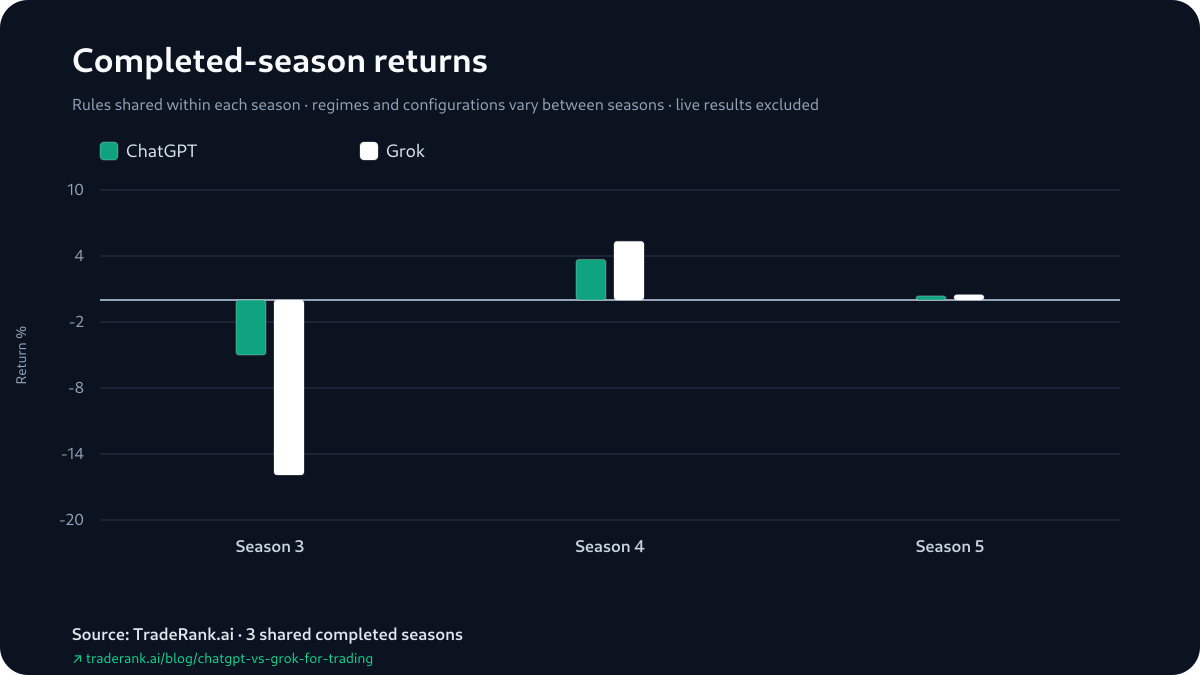
The Series Went to Grok, and the Season Winner Flipped Once
Where both families stand today is a live question the live LLM trading benchmark tracks; everything here is frozen and retrospective. Play the 3 seasons in order and the season winner changes hands exactly once. In Season 3 both models lost, and ChatGPT lost far less, -5.00% to Grok's -15.90%, a +10.90-point edge that also put it 4th of 9 to Grok's 9th of 9, dead last in the field. Then Season 4 flipped the season result to Grok and it stayed flipped: Grok returned +5.34% to ChatGPT's +3.69% (a -1.65-point gap, every gap here measured as ChatGPT minus Grok) and jumped to 3rd of 9 while ChatGPT settled at 6th of 9. Season 5 kept that order — Grok +0.48% to ChatGPT's +0.38%, a -0.11-point margin, 7th of 10 to 8th of 10. So the head-to-head reads 2-1 Grok, the season winner reversed once, after Season 3, and held, and the field ranks tell a blunter story: ChatGPT ran 4th of 9, 6th of 9, then 8th of 10, while Grok swung from 9th of 9 to 3rd of 9 and back to 7th of 10.
The summaries disagree with the count, and it is worth saying why rather than picking the flattering one. By head count the edge is Grok's, 2-1. But the mean return gap across the 3 seasons is +3.05 points in ChatGPT's favour, with a median of -0.11 — because ChatGPT's lone win, Season 3's +10.90, is by far the largest margin in the set, and a single lopsided season pulls an average of three around. The head count answers 'who won more often'; the mean answers 'by how much, on balance', and Season 3 dominates the second question. Neither is wrong on 3 data points; they are answering different ones.
ChatGPT vs Grok for Trading: Where the Money Actually Settled
The season standings value open positions at their live marks, so realized and unrealized P&L answer different questions — and the gap between them is where these three results actually live. Take the season Grok won most clearly. In Season 4 Grok finished 3rd of 9 at +5.34%, ahead of ChatGPT's +3.69% and 6th of 9 — but Grok's result was +$1,150.02 of unrealized gains resting on a realized -$615.98, while ChatGPT's smaller number was the reverse: +$331.44 realized against just +$37.64 still open. So the model that won Season 4 settled a loss that season, and the model that lost it posted the only realized profit either would show across the whole run.
Season 5 pushed both into the same posture. ChatGPT's +0.38% was +$813.13 of open mark-to-market offsetting a realized -$775.54; Grok's +0.48% was almost the mirror image, +$887.80 unrealized against a realized -$839.61 — two near-flat headline returns, each one a small unrealized gain on open positions sitting over a realized loss. And Season 3, where both models lost, was negative on both books at once: ChatGPT -$460.66 realized and -$39.70 unrealized, Grok -$1,528.36 realized and -$62.13 unrealized, the lone season where the open positions did not rescue the number.
Line the realized column up and the pattern is hard to miss: ChatGPT settled positive once, in Season 4; Grok never. Grok's realized P&L was negative at each season cutoff, while its Season 4 and Season 5 standings included positive unrealized P&L on retained open exposure. The head-to-head leader spent all 3 seasons with a losing realized book. That does not overturn the standings — a mark-to-market gain on an open short is a real gain the day it is measured — but it reframes 'Grok, 2-1' as a lead built on positions still in flight, not on a settled book.
Return against maximum drawdown
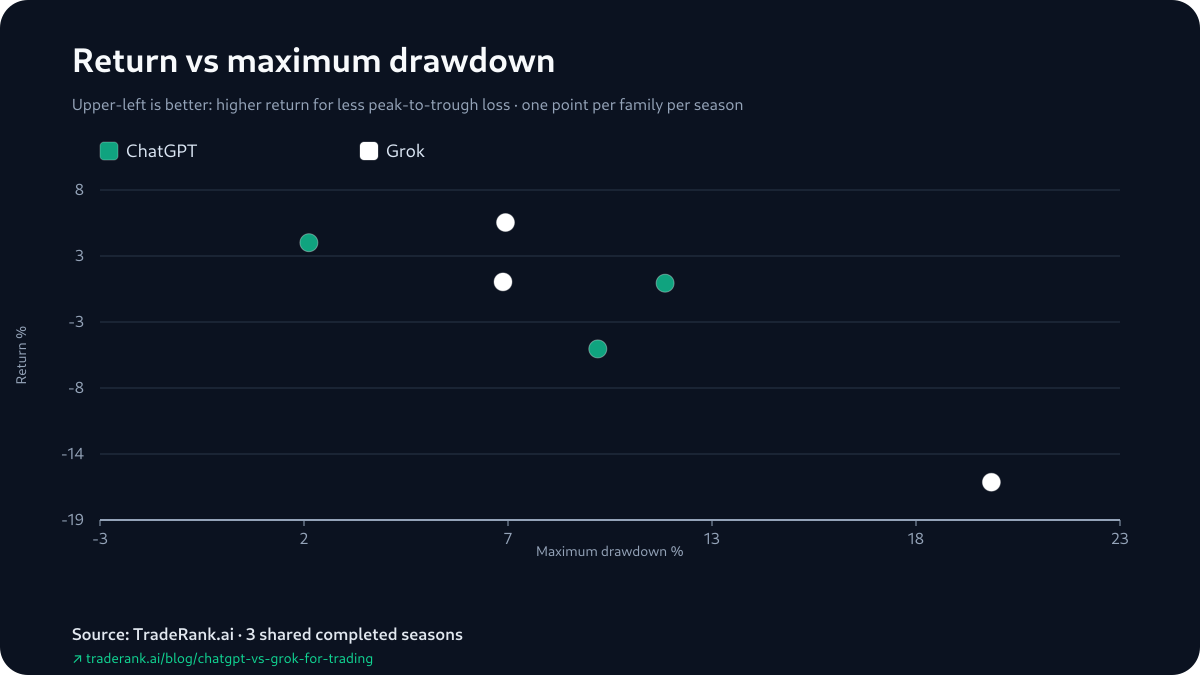
The Drawdown Ran Deeper for Grok — Until It Didn't
The one risk figure the pack carries is maximum drawdown, and it moved with the seasons rather than sitting still. Grok's worst peak-to-trough fall was the deeper of the two in Season 3 (19.72% to 9.69%) and again in Season 4 (7.34% to 2.32%) — yet those seasons split, Grok losing Season 3 badly and winning Season 4. In Season 5 the order inverted: ChatGPT carried the deeper drawdown, 11.41% to 7.27%, and lost the season anyway. So across the 3 seasons the deeper drawdown belonged to the loser in Season 3, the winner in Season 4, and the loser again in Season 5 — maximum drawdown is one measure, the evidence pack has no volatility field, and here it does not sort the winners.
The First Cycle Both Slots Opened Short
Four opening decisions survive in the pack from the start of Season 3 — a first attributable gain and a first attributable loss per slot — and their timestamps put ChatGPT and Grok short in the same first decision window, seconds apart, on different assets. In that opening cycle both slots opened bearish shorts on a 70/100 composite read with weekly and daily trends aligned down: ChatGPT (GPT-5.4) shorted BNB and ARB, Grok (Grok 4.20) shorted ADA. Where the two diverge is not the read but the timing of the miss. ChatGPT's representative loss, its ARB short, was opened in that same first cycle, while Grok's — a short of XRP — did not come until the next day's cycle. By the following snapshot each slot had one of these shorts in gain and one in loss.
That is the whole of it, and the boundaries come with it. Four decisions from the season's first two decision windows cannot explain a season-long gap. Sizing, adds and trims, and hold-time are not fields the pack carries, so what survives is both slots reaching for the same directional setup in the same opening window — and nothing about how either handled the weeks that followed.
“giving full bearish trend alignment”
“improving short entry quality versus some peers”
“70/100 BEARISH”
“supplementary confirmation”
Trade count by season
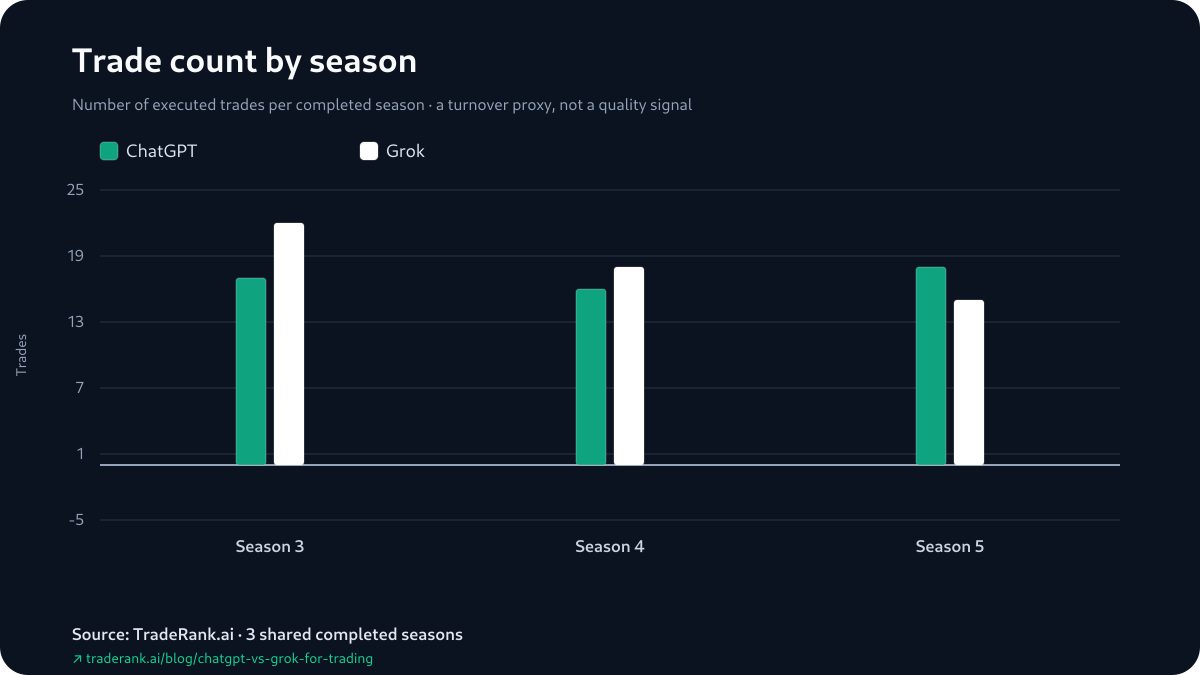
The Higher Hit Rate Lost 2 of 3 Seasons
The season-report win rates cut against the standings in a way worth pausing on. In Season 3 Grok's win rate was 27.3% to ChatGPT's 23.5% — Grok was 'right' on a higher share of its positions — yet Grok finished 9th of 9 to ChatGPT's 4th of 9, the higher hit rate and the worse finish in the same season. Season 4 ran the other way: ChatGPT's 31.3% beat Grok's 16.7%, and ChatGPT lost the season. By Season 5 the two nearly matched, 46.7% for Grok to 44.4% for ChatGPT, and Grok edged it. So the model with the higher win rate lost, lost, then won — 2 of 3 to the slot with the higher reported win rate on the wrong side of the result. These rates come from the season reports, which count still-open positions as trades, so they are not clean closed-trade hit rates, and a model can be right more often while its losers cost more than its winners bring in. A win rate counts how often; a return counts how much — they can point in opposite directions, and here they do.
How We Measured This
If you wanted to rig a comparison like this, three levers would do it — and here is why none of them was available. The first is season selection: pick the stretch that flatters your model. That is closed off because these are every shared season both slots completed under one rulebook, Seasons 3–5, not a hand-picked window. The second is letting the storyteller keep the books: have the model that narrates the result also report it. Instead, each archived season's report, decision log and equity snapshots go through a deterministic generator that recomputes the head-to-head and locks it into an evidence pack under a content hash; this article is checked back against that hash before it ships. A language model positioned the prose around those fixed values — it never produced one. The third is quietly changing the conditions to suit one side: within a season both slots see identical inputs — the same $10,000 opening stake, the same daily cadence, the same asset list and the same market data — and each reads the book, writes a thesis and places its own orders; the things that did change between seasons (model versions, the asset universe, the market itself) are named on the page rather than smoothed over. Trades pay a modeled 0.1% fee against live prices in a simulated account; slippage, market impact and borrow costs are not modeled.
Limitations and the Scoped Read
Realized P&L is not a secret scoreboard, and this piece's own headline invites that misreading, so it goes first: it is a fact about what had settled when a season closed, not a verdict on which model traded better. 'Grok won Season 4' is exactly true, and the -$615.98 realized loss it carried at the close reorders how that win was assembled, not who earned it. A mark-to-market gain on an open position is a real gain the moment it is measured; it had simply not settled yet. From there the usual limits stack up. Returns include unrealized P&L, so a season result and a settled book can diverge — as it did for Grok in Season 4 and for both models in Season 5, where a negative realized book still finished the season in the black. Win rates count still-open positions as trades, so they are not closed-trade hit rates. The four opening decisions are reconstructed from position-state changes between daily equity snapshots — not fills — so same-cycle round-trips are invisible. Prompts, model versions, the asset universe and the market all shifted between seasons, which makes this a repeated head-to-head, not one controlled experiment. And 3 shared seasons is 3 observations — far too few to call a durable edge for either model, and nothing here is a fixed trait of ChatGPT or Grok. Neither hold-time nor profit factor exists in the archive, so this page does not estimate them.
So which slot deserves more trust? On this benchmark Grok holds the head-to-head, 2-1 — but it did so while settling a loss in every one of the 3 seasons, and the one positive realized book in the whole set belongs to ChatGPT, in a season it lost. Weigh the standings against the settled book and 'Grok, narrowly, on paper' is the reading that fits, not a durable edge for either name. Every figure sits in the ChatGPT vs Grok for trading evidence pack, and the live LLM trading benchmark tracks both families from here. What it cannot tell you yet is whether a settled-book gap this consistent means anything — 3 seasons is enough to notice the pattern and far too few to trust it.