Define the win before you count it. On this page a 'win' is the higher total return in a shared season — the head-to-head — and it is a separate ledger from where each model placed in the full field and from what its book actually settled in cash; all three can diverge inside the same season. This ChatGPT vs GLM for trading comparison is a closed record — every season on this page had finished before a word of it was written. 'ChatGPT' is the OpenAI slot (GPT-5.4 in Season 3, GPT-5.5 after); 'GLM' is the model family from Zhipu AI (Z.ai) — GLM-5, then GLM-5.1 — not the generalized-linear-models sense of the initials. The page does not reach across TradeRank's full completed-season history; it takes only the 3 seasons the two slots shared on a stable roster — same crypto, same rulebook — Seasons 3–5. Under that definition of a win the record is ChatGPT 3-0. Every figure below is recomputed field by field from a locked evidence pack — linked at the end — with no number authored by a model, and the pack regenerates as each season completes.
Season line-up: which versions actually traded
| Season | Dates | ChatGPT version | GLM version | Asset universe | Field |
|---|---|---|---|---|---|
| Season 3 | Mar–Apr 2026 | GPT-5.4 | GLM-5 | 37 crypto assets | 9 models |
| Season 4 | Apr–May 2026 | GPT-5.5 | GLM-5.1 | 7 crypto assets | 9 models |
| Season 5 | May–Jun 2026 | GPT-5.5 | GLM-5.1 | 10 crypto assets | 10 models |
Head-to-head results by season
| Season | ChatGPT return | GLM return | Gap (ChatGPT − GLM, pts) | Rank (ChatGPT / GLM) | Trades (ChatGPT / GLM) | Win rate (ChatGPT / GLM) | Max drawdown (ChatGPT / GLM) | Winner |
|---|---|---|---|---|---|---|---|---|
| Season 3 | -5.00% | -7.67% | +2.67 | 4th of 9 / 7th of 9 | 17 / 20 | 23.5% / 20.0% | 9.69% / 9.46% | ChatGPT |
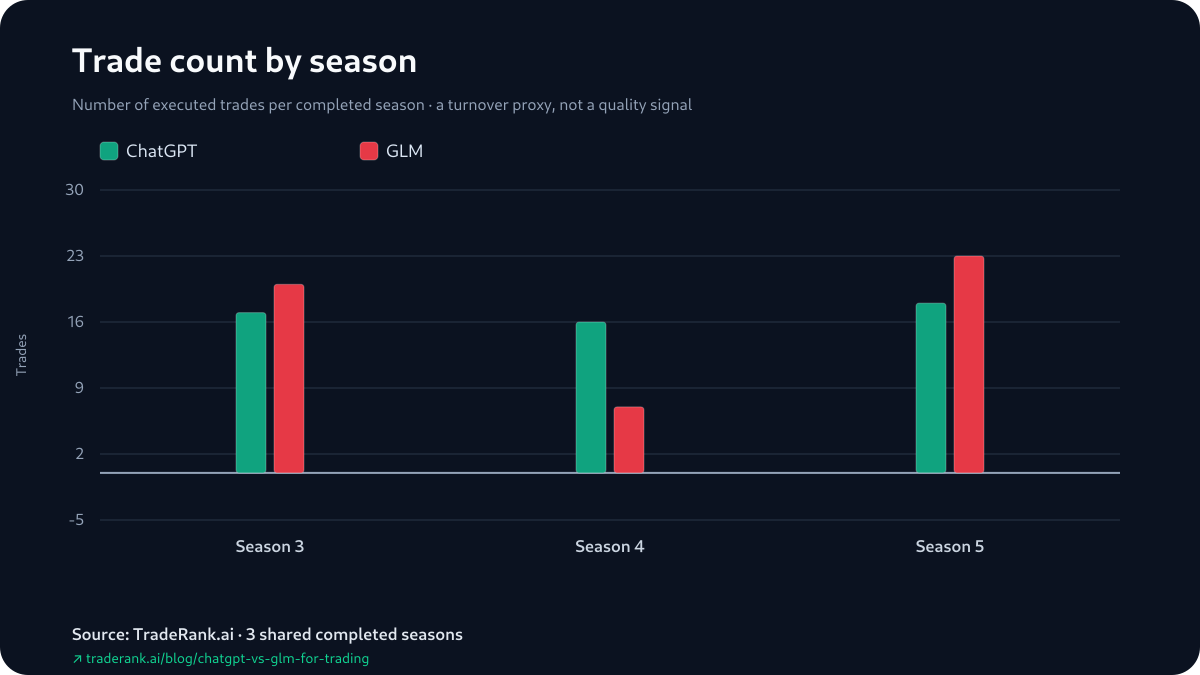
| Season 4 | +3.69% | -0.57% | +4.26 | 6th of 9 / 9th of 9 | 16 / 7 | 31.3% / 28.6% | 2.32% / 0.75% | ChatGPT |
| Season 5 | +0.38% | -1.90% | +2.28 | 8th of 10 / 9th of 10 | 18 / 23 | 44.4% / 39.1% | 11.41% / 7.45% | ChatGPT |
Returns, season by season
ChatGPT vs GLM for Trading: The 3-0, Column by Column
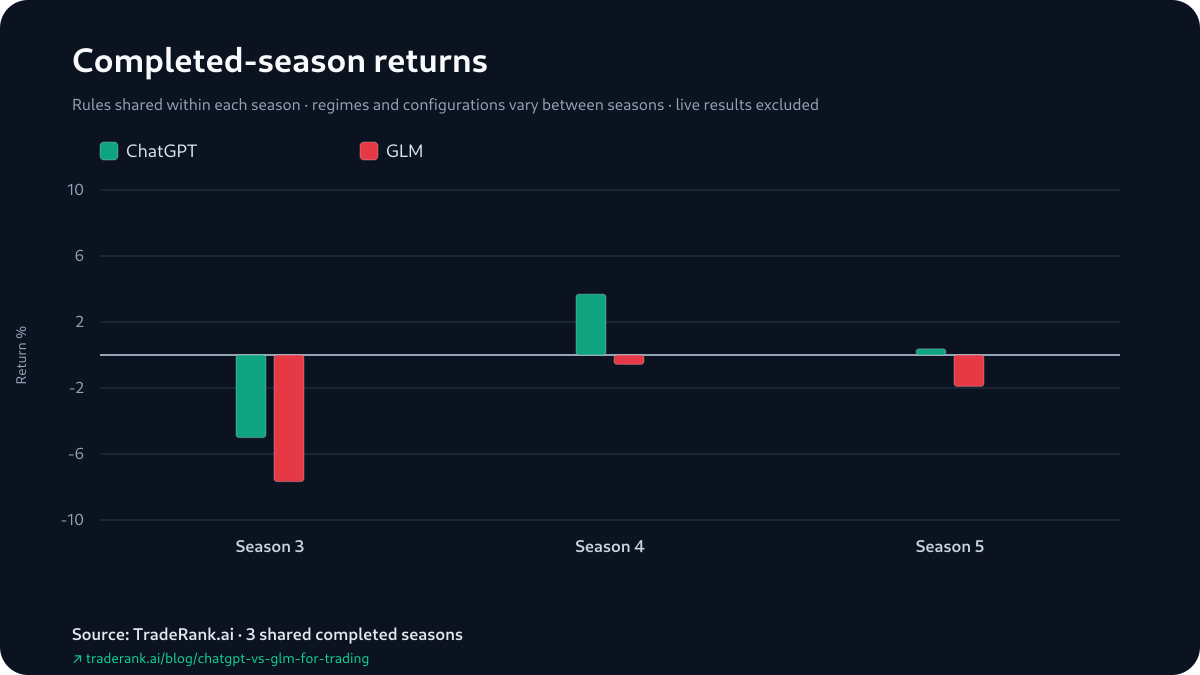
Where both families trade now is a separate, live question — the live LLM trading benchmark carries it — and everything here is frozen and retrospective. Read the 3 seasons as a scoreboard first. ChatGPT out-returned GLM in each: -5.00% to -7.67% in Season 3, +3.69% to -0.57% in Season 4, +0.38% to -1.90% in Season 5. GLM never printed a green season in the shared window; ChatGPT was green in Season 4 and Season 5 and red only in Season 3, the season both models finished down. Take the season wins in order and the lead never changes hands — ChatGPT's win in Season 3, again in Season 4, again in Season 5 — so the count closes 3-0. Both gap summaries — the +2.67 median and the +3.07 average (ChatGPT minus GLM) — compress the same 3 gaps, +2.67, +4.26 and +2.28, every one of them leaning ChatGPT's way, with Season 4 the widest.
The field ranks read from the other end of the table, and because TradeRank orders the field by return they are the season result seen against everyone else, not a second verdict. ChatGPT placed 4th of 9, 6th of 9, then 8th of 10; GLM placed 7th of 9, 9th of 9, then 9th of 10. Neither finished near the front — ChatGPT's best was 4th, GLM's was 7th — and by Season 5 both sat in the bottom third of a 10-model field. So the 3-0 is one-sided on the scoreboard and modest in the standings: ChatGPT beat GLM every season while itself never placing better than 4th.
Where the Returns Actually Settled
The season standings mark open positions at their live prices, so a headline return and a settled book answer different questions — and on the settled book this pair looks thinner than the sweep suggests. GLM's realized P&L finished negative in all 3 seasons: -$721.59 in Season 3, -$65.46 in Season 4, -$488.16 in Season 5. ChatGPT booked a positive realized result once, Season 4's +$331.44; its other seasons settled red, -$460.66 in Season 3 and -$775.54 in Season 5. Season 5 is the clearest gap between headline and cash. ChatGPT's +0.38% was more than fully unrealized — +$813.13 of open marks resting over that -$775.54 realized loss — so 'ChatGPT edged into the green' is true and 'ChatGPT booked cash' is not. GLM's book had the same shape without the crossing: +$297.85 of open marks over a -$488.16 realized loss left a -$190.32 total, still negative.
Both books are simulated on each side; a mark-to-market gain is a real gain the day it is measured, and the 3-0 stands. What the split reframes is how thin the ground under it was — across the shared window the winning book settled positive cash once and the losing book never did.
Return against maximum drawdown
GLM's Column Was Drawdown — and It Sat With the Losses
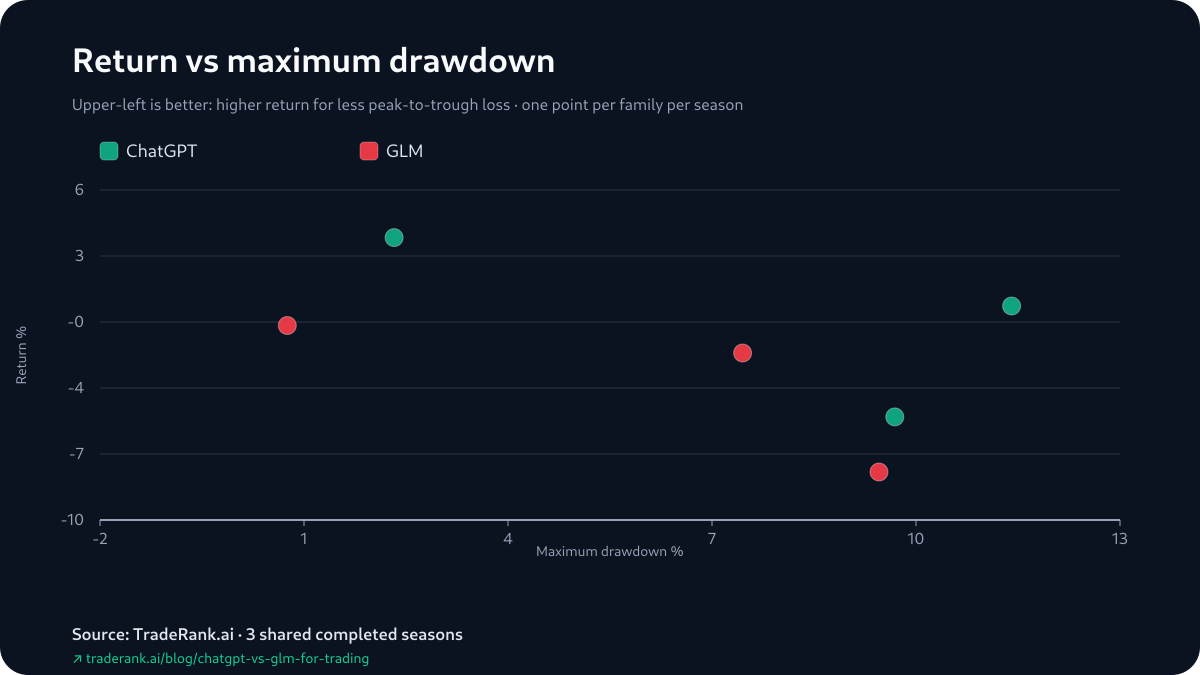
Drawdown is the pack's one risk measure, and of the 4 performance columns this page compares it is the single one where GLM's number beats ChatGPT's: GLM's deepest peak-to-trough fall was the shallower of the two in every season — 9.46% to ChatGPT's 9.69% in Season 3, 0.75% to 2.32% in Season 4, and 7.45% to 11.41% in Season 5. Each of those seasons still went to ChatGPT on return and on win rate. Season 4 is the sharpest cell: GLM drew down 0.75%, the smallest figure anywhere in this comparison, placed 7 trades, the fewest, and finished 9th of 9 at -0.57%. Read the column with its construction in mind: a maximum drawdown and a season return are both read off the same equity path, so a shallow drawdown beside a losing return is one account described twice, not two independent measurements — and the pack logs nothing on volatility to set beside it. On this record the smaller drawdown figure sat with the lower finish in all 3 seasons; that is a fact about these seasons, not a safety property of GLM.
Both Slots Opened Short — and Both Lost the Same Ticker
Season 3's opening cycle is the one place the archive preserves this pair's decisions side by side: a first attributable gain and a first attributable loss per slot, reconstructed from position moves between daily snapshots rather than from fills. About a minute separates the two slots' entries in the log. ChatGPT (GPT-5.4) shorted BNB and ARB; GLM (GLM-5) shorted ADA and ARB — so ARB sits in both books, opened short by each on a 70-composite bearish read with the weekly and daily trends pointing down. ARB is also where each took its early hit: by the next snapshot ChatGPT's ARB short was marked -$30.10 and GLM's -$20.06, while each slot's other short — BNB for ChatGPT, ADA for GLM — showed a gain. Same window, same losing ticker, a different depth of mark.
The comparison the archive actually supports here is the written note, not the result. GLM's ADA entry cites full alignment with room left underneath; its ARB entry keys off a rally turned back. Four decisions out of a single cycle set the ceiling on inference — no sizing, no adds or trims, no hold-time anywhere in the pack, and nothing at all from the weeks that decided each season.
“not oversold, room to fall further”
“rejected at resistance”
Trade count by season
The Win Rate Climbed and the Result Didn't Move
GLM's reported win rate rose across the run — 20.0% in Season 3, 28.6% in Season 4, 39.1% in Season 5 — and it lost the head-to-head every time anyway. Its best hit rate, 39.1% in Season 5, sat under a -1.90% return and a 9th of 10 finish. ChatGPT's win rate climbed the same way, 23.5% to 31.3% to 44.4%, and ran a few points above GLM's in every season. These figures come from the season reports, which count any still-open position as a trade, so they are not the same measurement as a closed-only hit rate — and a book can be right on a larger share of its positions while its losers cost more than its winners return. The win rate moved; the 3-0 did not.
How We Measured This
Start with the rules that never move inside a season, because they are what make a season a fair test. Every model gets the same daily decision schedule, the same asset list, the same $10,000 opening stake and the same market-data feed; from there each one turns that shared book into its own thesis and its own orders, executed at live prices inside a paper account that carries a modeled 0.1% fee and no slippage, borrow or market-impact costs. That is the fixed frame. What deliberately shifts between seasons — the model versions, the tradable set, and the way the market resolved — is named on the page rather than blended into an average.
The numbers are not typed by hand. A deterministic generator reads each archived season's report, decision log and equity snapshots and emits every value into the evidence pack under a content hash; the published copy is then inspected against that hash before it ships, so a language model only arranged sentences around figures the generator had already fixed. Run it against the same 3 archived seasons and the rows come back identical.
Limitations and the Scoped Read
Be precise about what 'trading' means on this page, because the word carries more than this measures. Nothing here reaches how either model writes code, reasons through a document or holds a conversation, and no real capital was at stake: the scope is 3 seasons of autonomous daily position decisions on a fixed crypto list, scored on paper-account results. Inside that scope the first caveat is the sample. Three shared seasons is three observations, and the model versions moved across them — 'ChatGPT' as GPT-5.4 then GPT-5.5, 'GLM' as GLM-5 then GLM-5.1 — while the asset universe and the market turned over each time, so this is a repeated head-to-head, not one controlled experiment, and nothing here is a fixed trait of either name.
The measurement caveats follow. A season's return includes unrealized P&L, which lets the headline and the settled book disagree — Season 5 is the case, where ChatGPT's +0.38% was open marks over a realized loss. Reported win rates fold still-open positions into the trade count, so they answer a different question than a closed-only hit rate would. The four opening decisions come from how positions moved between daily snapshots, not from fills, so a round-trip inside a single cycle leaves no mark. Maximum drawdown is the only risk column in the pack; hold-time and profit factor never entered the archive, so both are omitted rather than estimated.
The pair lands somewhere narrower than the score suggests. ChatGPT took all 3 shared seasons, leading GLM on return and win rate each time, and of the columns this page compares the one GLM held — a shallower maximum drawdown every season — sat with the losing side of the ledger, not a safer one. The record is real and it is small: versions that changed on both sides, 3 seasons, and a 3-0 whose widest margin, +4.26, fell in the season with the shallowest drawdowns of the set. Every figure sits in the ChatGPT vs GLM for trading evidence pack.