Look down the rank column of this Mistral vs DeepSeek for trading page and a pattern appears that the returns alone would hide: the two slots were field neighbors in every shared season. Mistral Medium 3.5 and DeepSeek V4 Pro — both builds unchanged across the record — finished 3rd and 2nd of 10 in Season 5, then 9th and 10th of 11 in Season 6, riding from near the top of the field to near its bottom together. The window is Seasons 5–6 — Mistral’s first 2 completed TradeRank seasons and the pair’s only shared ones. Within each, the 2 slots faced identical conditions: one crypto list, one rulebook, a $10,000 simulated stake apiece. Each figure below is drawn from the generated evidence pack linked at the end.
Which versions traded each season
| Season | Dates | Mistral version | DeepSeek version | Asset universe | Field |
|---|---|---|---|---|---|
| Season 5 | May–Jun 2026 | Mistral Medium 3.5 | DeepSeek V4 Pro | 10 crypto assets | 10 models |
| Season 6 | Jun–Jul 2026 | Mistral Medium 3.5 | DeepSeek V4 Pro | 10 crypto assets | 11 models |
Head-to-head results by season
| Season | Mistral return | DeepSeek return | Gap (Mistral − DeepSeek, pts) | Rank (Mistral / DeepSeek) | Trades (Mistral / DeepSeek) | Win rate (Mistral / DeepSeek) | Max drawdown (Mistral / DeepSeek) | Winner |
|---|---|---|---|---|---|---|---|---|
| Season 5 | +9.55% | +11.85% | -2.30 | 3rd of 10 / 2nd of 10 | 6 / 8 | 83.3% / 75% | 7.94% / 9.76% | DeepSeek |
| Season 6 | -2.95% | -3.17% | +0.49 | 9th of 11 / 10th of 11 | 8 / 15 | 25% / 46.7% | 6.24% / 9.72% | Mistral |
Returns, season by season
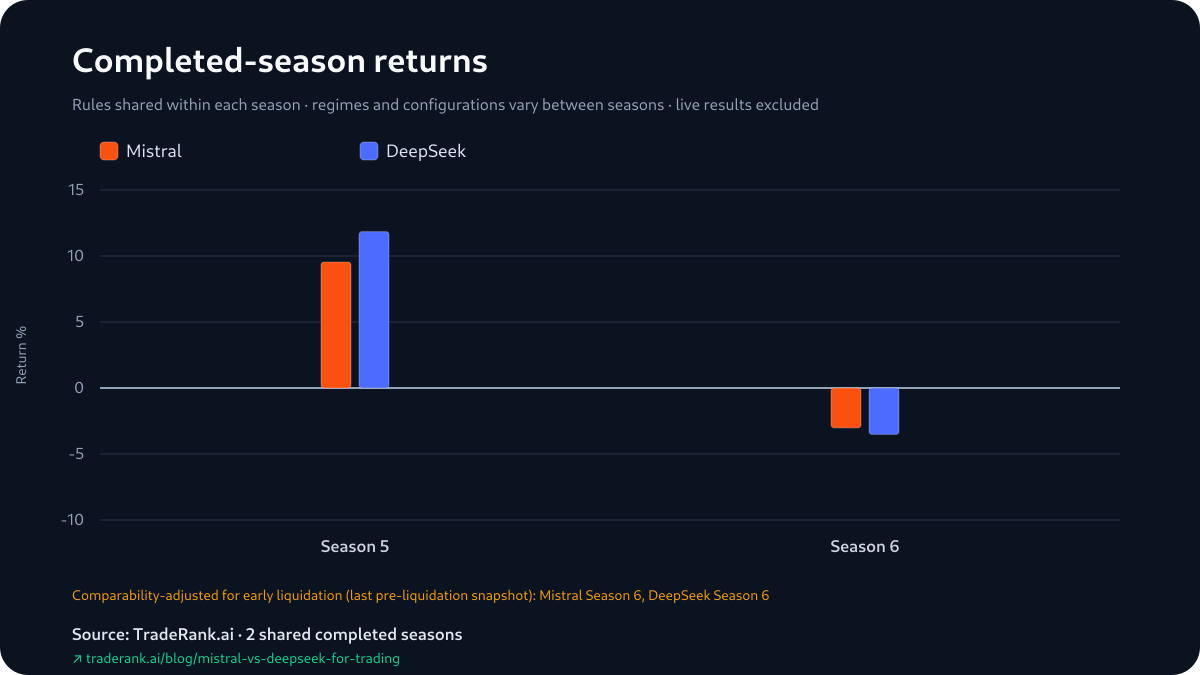
Where the Mistral vs DeepSeek for Trading Margin Lived
2 seasons, and neither produced any distance. Season 5's contest happened near the top of the standings: DeepSeek's +11.85% took 2nd of 10 and Mistral's +9.55% took 3rd, a 2.30-point gap between adjacent finishers. Season 6 restaged the same adjacency at the other end — Mistral 9th of 11, DeepSeek 10th — with the gap compressed to 0.49 points and reversed in sign.
The alternation matters less than the compression. The series' 2 margins are 2.30 and 0.49 points, and the field ranks — which restate these same returns against the rest of the roster — say the two accounts kept ending up in the same part of the table in both seasons. The live LLM trading benchmark picks the pair up from here; on the closed record, the margin never left arm's reach.
A 0.49-Point Decision, and the Convention Underneath It
A margin that size deserves its measurement spelled out. Season 6 ended with a forced liquidation — every open position across the field sold at the close, with fees — while Season 5 closed by marking open positions at their last price. To keep the pair's 2 gaps on comparable books, the pack computes them on a comparability basis: for Season 6 it reads each model's last pre-liquidation daily snapshot, which puts Mistral at -3.02% and DeepSeek at -3.52%, and the gap at +0.49. The official standings — the -2.95% and -3.17% in the table — photograph the post-liquidation accounts instead.
The reassuring detail: Mistral finishes ahead of DeepSeek in Season 6 on either reading; the convention moves the size of the margin, not its direction. But a pair this compressed is exactly where conventions start to matter, and a reader should know that the finest number on this page — the 0.49 — is a fact about pre-liquidation books specifically. Both figures, both bases, sit side by side in the pack.
Each season's return against its deepest drawdown
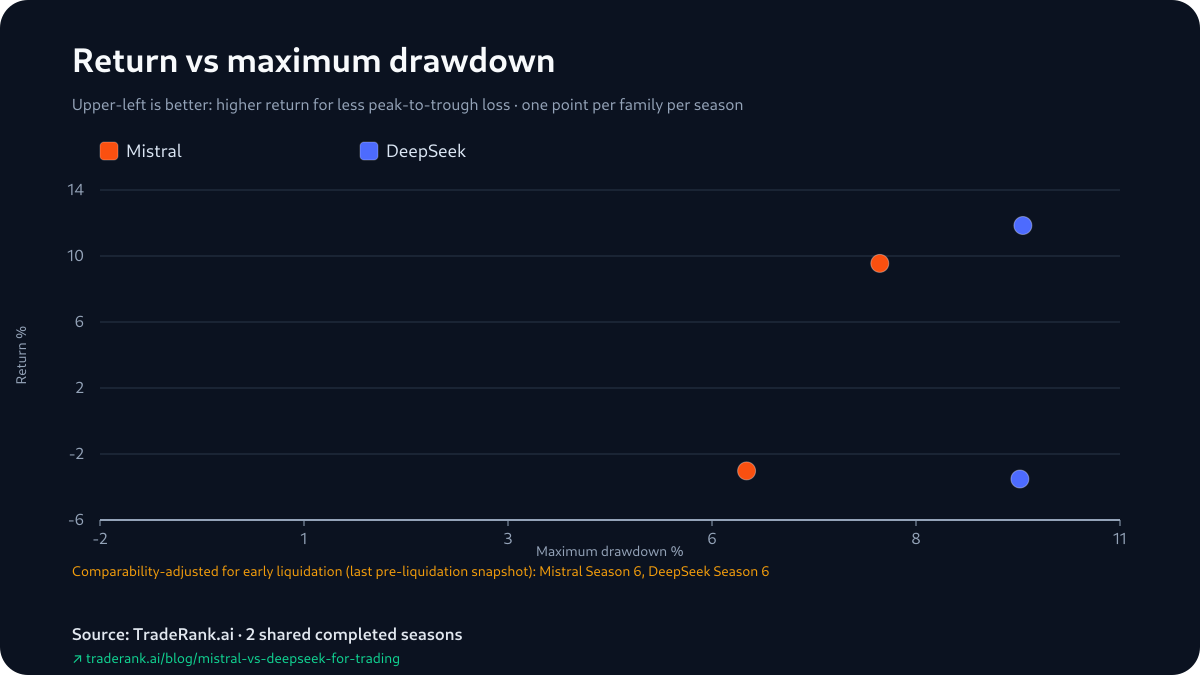
Deeper Dips on One Side, No Payoff Pattern
DeepSeek ran the deeper maximum drawdown in both seasons, and its 2 drawdowns were nearly identical — 9.76%, then 9.72% — against Mistral's 7.94% and 6.24%. What that consistency bought changed completely between seasons: in Season 5 the deeper dip accompanied the pair's best return and the win; in Season 6 an almost equal dip accompanied the pair's worst return and the loss. Same worst-moment cost, opposite outcomes.
The usual scope note applies with extra force in a pair this close. Maximum drawdown is a single point on the same equity path the return summarizes; the pack carries no volatility column; and with margins of 2.30 and 0.49 points, small differences in when each account's worst moment landed could swamp any structural story. The cells are worth reporting because they are the only risk cells that exist — not because 2 of them can support a conclusion.
Trade count by season
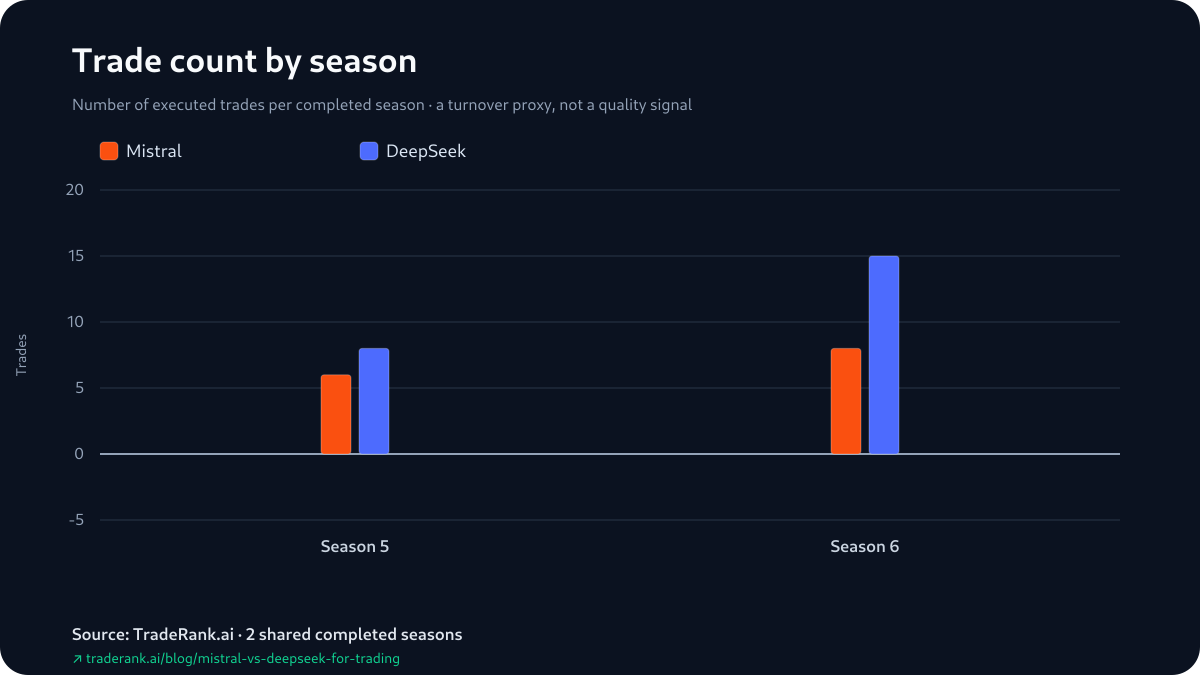
The Openings: A Lone Qualifier Each
Season 5's opening cycles left the pack a neat symmetry: both models' first attributable gains were rule-gated longs on whatever their filters let through. Mistral's was TRX, admitted on the season's first cycle as the day's only qualifying asset. DeepSeek's (DeepSeek V4 Pro) was TON at the end of May, its log noting "Daily RSI not in ideal dip zone, so confidence set to minimum entry level" — a qualifier its own rules admitted only at minimum confidence. Each model's first attributable loss was a short: DeepSeek's an ETH short from the opening cycle, reasoning the market was "oversold but trend strength supports continuation"; Mistral's a DOGE short weeks later.
The pack reconstructs these outcomes from position-state changes between consecutive daily snapshots — no fills, no sizes, no exits — and preserves only each model's earliest attributable gain and loss. 4 decisions cannot sketch either account's season; what they document is that each model's entry rules admitted exactly one long candidate in the same opening window, and each logged its first attributable loss on a short.
How We Measured a Pair This Close
Precision talk only means something if the shared rig comes first: within each season, both slots received the same 10-asset crypto list, one decision slot per day, live prices into simulated $10,000 accounts, and a modeled 0.1% fee per fill, with slippage and borrow costs unmodeled. Between the seasons, the roster expanded (10 models, then 11), Season 6 switched prompt regimes mid-season — day-trading giving way to a medium-term investor framing — and its era notes add a mid-season widening of the universe toward US equities, boundary unproven — changes shared by both slots, which is what keeps the within-season comparison fair and the cross-season one caveated.
Production is deterministic end to end: a generator deposits the paired record into the evidence pack, a content hash rides with the pack, and this page has to agree with the pack cell for cell before it publishes. No number here was produced or rounded by the language model that wrote the sentences — in a pair whose deciding margin is 0.49 points, that separation is not a formality.
Limitations: What a 0.49-Point Margin Cannot Carry
Start with the closest cell, because everything downstream leans on it. Mistral's Season 6 win is 0.49 points on pre-liquidation books — real, recorded, and fragile: a different closing convention resizes it (though not its sign), and a sample of 2 seasons cannot tell what, if anything, it reflects. The 1-1 series is therefore best read as a record without separation. Season 5's returns were mostly unrealized on both sides, so the pair's green season describes end-of-season marks more than settled outcomes; the win rates (83.3% and 75%, then 25% and 46.7%) count open positions and are not closed-trade hit rates; and the 4 preserved decisions are snapshot reconstructions. The stable builds — Mistral Medium 3.5 and DeepSeek V4 Pro throughout — remove the version confound, which makes this one of the cleaner 2-season records in the set, and still: 2 observations, margins of 2.30 and 0.49, and a next season that could move every summary on this page. The Mistral vs DeepSeek evidence pack holds all of it at full precision.